


 By Rick Adams•September 4, 2026
Ask ten people what the gold price is and you'll get ten different numbers. One quotes the figure they saw on the evening news. Another quotes what their local jeweller offered for a broken chain. A third quotes the price of a Britannia coin from an online dealer. All of them are talking about gold, and none of them are quoting the same thing.
That confusion is exactly why I wanted to write this piece. When people ask me "what is the gold price?" - or type gold price meaning into a search bar - what they're usually after is this: where does that number on the screen actually come from, who decides it, and why does the price I get quoted never quite match it?
The short answer is that nobody sets the gold price. No government, no committee, no shadowy cabal in a Swiss vault. The price you see ticking away on GoldPrice.Live is the product of millions of buy and sell decisions happening around the clock, across London, New York, Shanghai, Zurich and beyond. The long answer is more interesting, and it's worth understanding properly if you own gold or plan to. So let's take it from the top.
Gold is unusual among commodities. Copper gets used up in wiring. Oil gets burned. Wheat gets eaten. Gold, for the most part, just sits there. Almost every ounce ever mined still exists in some form, whether in a central bank vault, a wedding ring, or a hoard buried in a field somewhere in Norfolk waiting for a lucky metal detectorist.
That means the gold price isn't really about consumption. It's about how much people want to hold the stuff, and what they're willing to pay for the privilege. Demand comes from jewellery buyers, investors, exchange-traded funds, industry in small amounts, and increasingly from central banks, which have been buying at a ferocious pace since 2022. Supply comes from mines, which add roughly 1.5 percent to the above-ground stock each year, and from recycling.
When you see the gold price move, you're watching the balance of those forces shift in real time. In January 2026 gold touched an all-time high just shy of $5,600 per ounce, driven by central bank accumulation, geopolitical worry and heavy fund inflows. It then pulled back sharply as some of that heat came out of the market. As I write this, we're trading in the low $4,000s. Same metal, same vaults, very different price. That's markets for you.
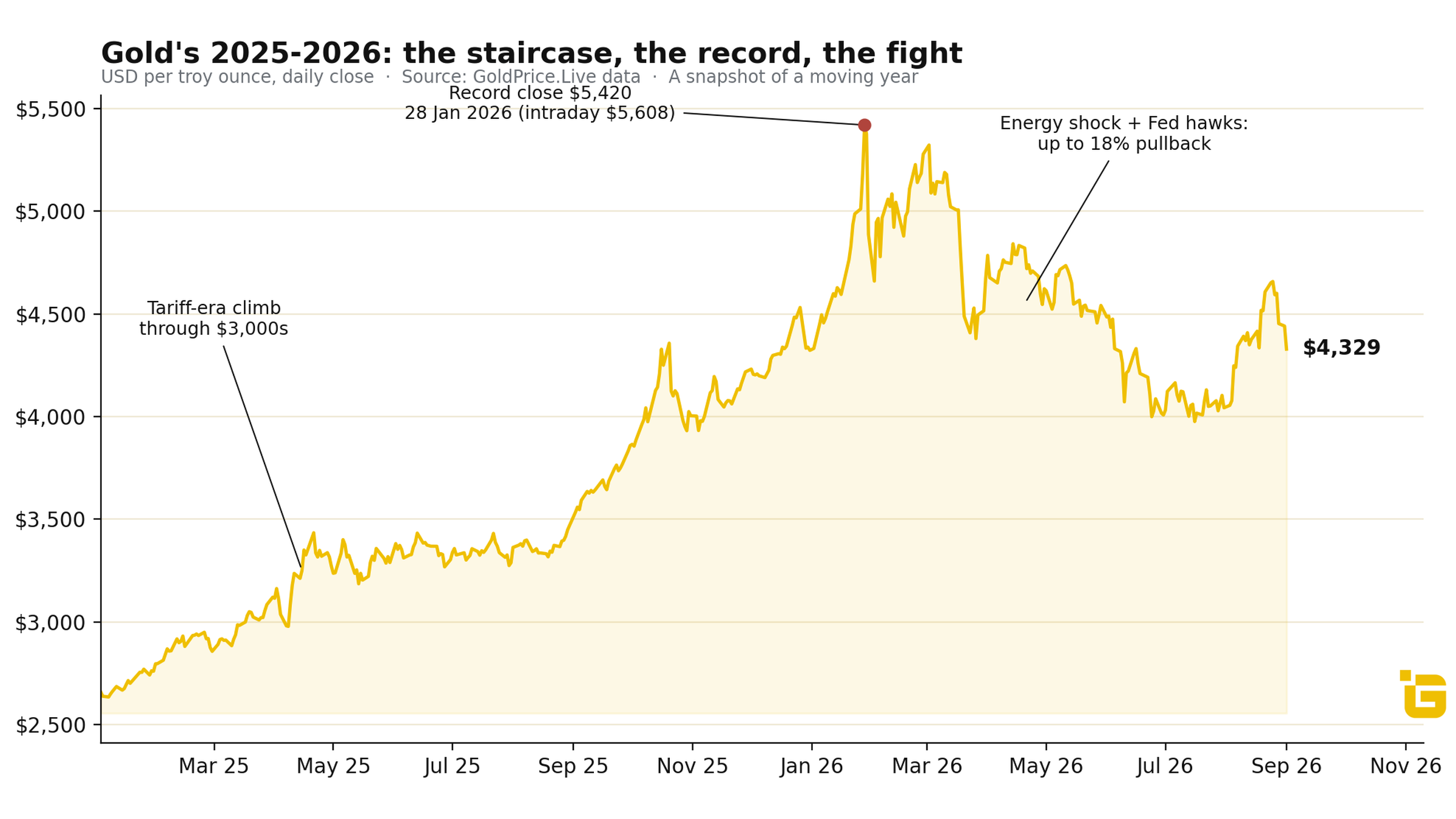 Half a century of the gold price: the market's verdict, updated daily since the dollar left the gold standard.
When someone says "the gold price", they almost always mean the spot price. Spot is the price for gold to be bought or sold right now, for immediate settlement, as opposed to at some agreed date in the future.
A few things to know about the spot price:
It's quoted per troy ounce. Not the ounce you weigh your flour with. A troy ounce is 31.1035 grams, about 10 percent heavier than the standard avoirdupois ounce. The troy system is a relic of medieval trade fairs in Troyes, France, and the bullion market has never seen a reason to modernise. When you see gold at $4,300, that's dollars per troy ounce of pure gold.
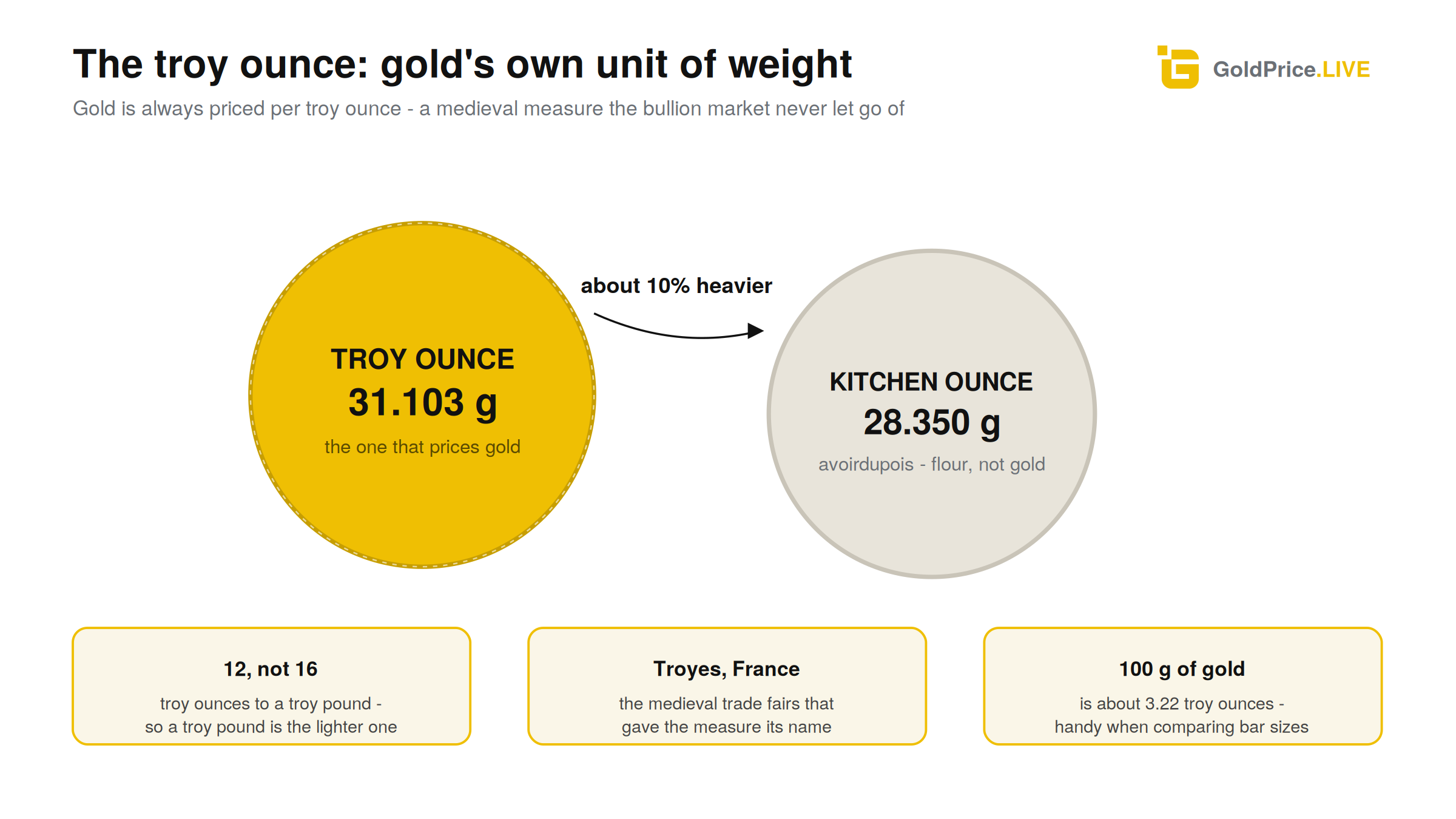 The troy ounce is about 10 percent heavier than the ounce in your kitchen - and it's the only one the gold market uses.
It's quoted in US dollars by default. Gold trades globally, but the dollar is the reference currency. Prices in pounds, euros, rupees or yen are conversions of that dollar price at prevailing exchange rates, which is why gold can hit a record high in sterling on a day it goes nowhere in dollars. More on that later.
It refers to large, wholesale quantities. This is the bit most people miss. The spot price is effectively the price at which banks and institutions trade 400 ounce Good Delivery bars in London, or their paper equivalents. It is not the price at which you or I can buy a one ounce coin. Retail products carry premiums for fabrication, distribution and dealer margin, which is why the coin in your hand always costs a bit more than spot.
It never really sleeps. Gold trades nearly 24 hours a day from Sunday evening to Friday evening, New York time, passing from Asian trading into London and then across to the US session. The price updates every few seconds while markets are open. There's no single closing bell, which is part of why different websites can show slightly different numbers at the same moment. They're pulling from different data feeds, all of which are legitimate snapshots of a constantly moving market.
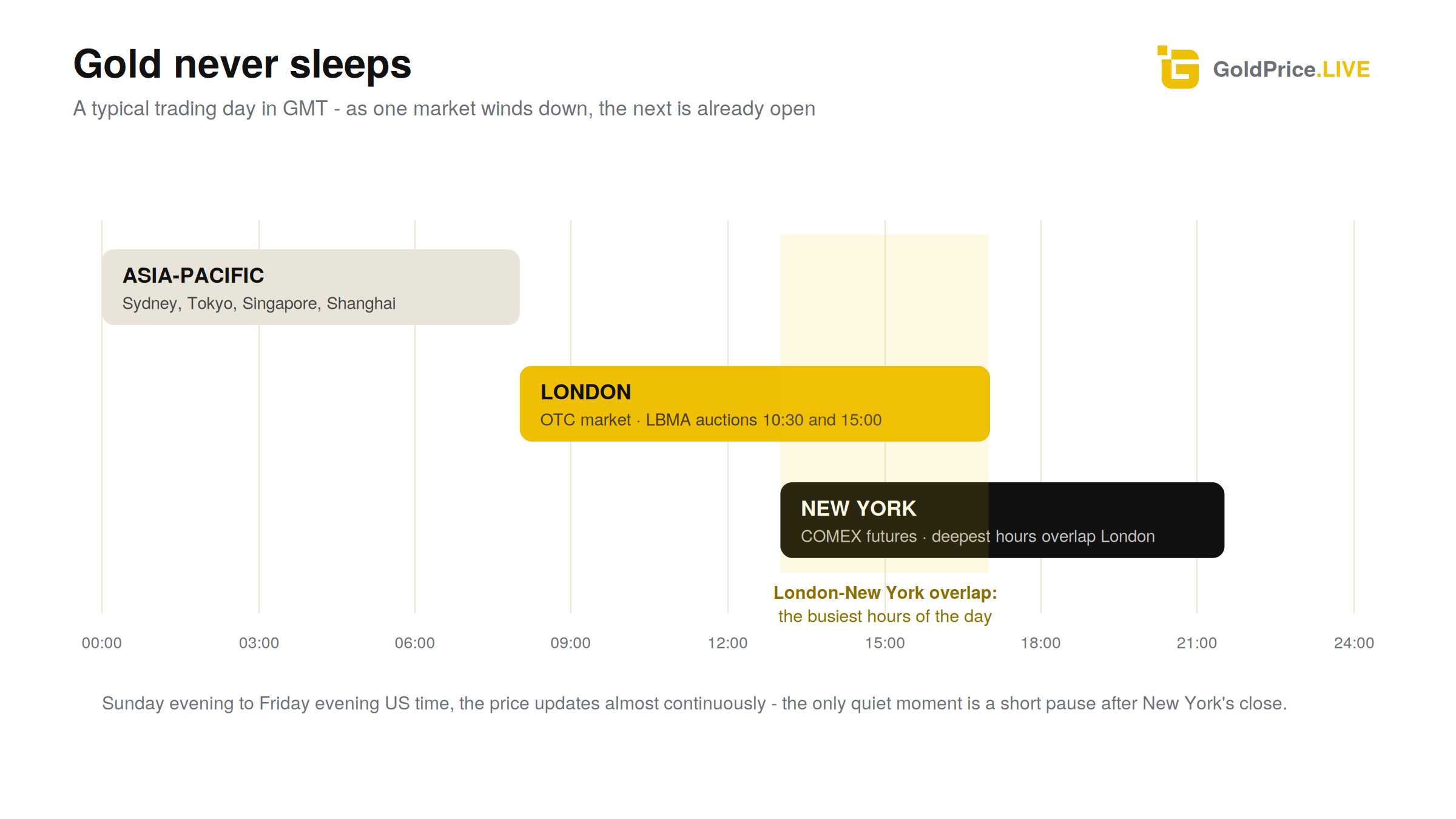 The trading day passes from Asia to London to New York, with the London-New York overlap the busiest stretch.
If you want to know what determines the gold price minute to minute, watch two cities. London and New York are the market's twin centres of gravity, and the spot price emerges from the interaction between them.
London has been the heart of physical gold trading for over three centuries. The market there is over-the-counter, meaning trades happen directly between participants - bullion banks, refiners, central banks, big investors - rather than on a public exchange. The London Bullion Market Association (LBMA) doesn't set prices, but it sets the rules: which refiners' bars qualify as Good Delivery, how trades settle, who gets to play.
The standard unit is the 400 ounce Good Delivery bar, minimum 99.5 percent purity, and gold held in London vaults is called "loco London". An astonishing amount of metal changes hands here. On a busy day, the notional volume cleared through London can exceed the entire annual output of the world's gold mines. Most of it is unallocated metal moving between accounts rather than bars being trolleyed around, but the point stands: London is where the deep physical liquidity lives.
The other pole is COMEX in New York, part of the CME Group, where gold futures trade. A futures contract is an agreement to buy or sell 100 troy ounces at a set price on a set future date. The overwhelming majority of these contracts never result in physical delivery. Traders close them out for cash before expiry. What COMEX provides is price discovery: a deep, fast, transparent market where hedge funds, banks, miners and speculators express their views on gold every second of the trading day.
In practice, the spot price you see quoted is derived from a blend of London OTC dealing and the most actively traded COMEX futures contract, with the two kept in line by arbitrage. If futures drift too far above spot, traders sell futures and buy physical until the gap closes. The whole system is self-correcting, which is precisely why no single institution can dictate the price for long.
I spent years as an analyst learning that markets this deep and this global are extraordinarily hard to push around. Individual traders have been fined for spoofing and manipulation at the margins, and rightly so, but the idea that the headline gold price is fixed by decree simply doesn't survive contact with how the plumbing works.
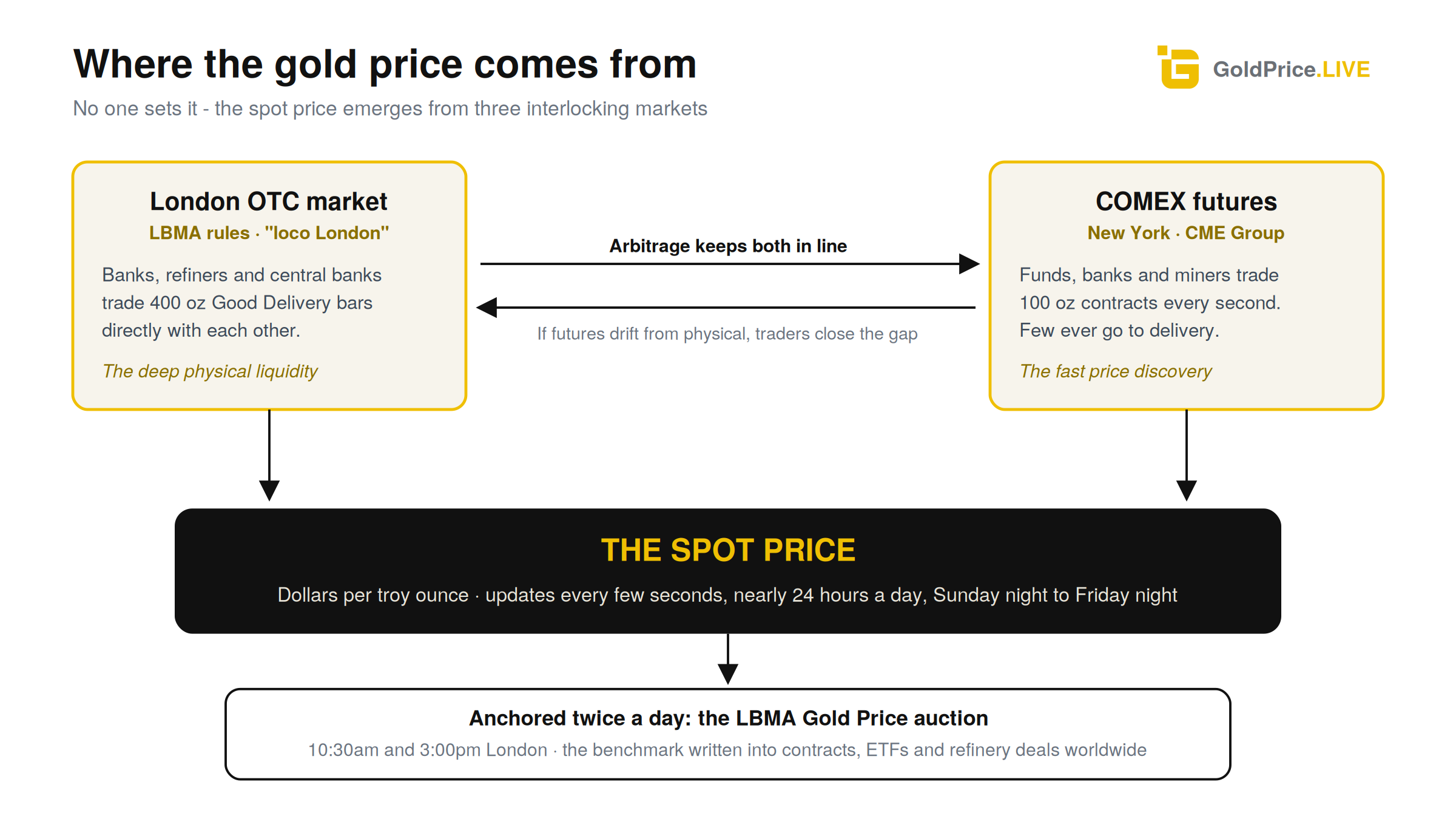 Two markets, one price: London's physical depth and New York's futures, kept in line by arbitrage and anchored twice a day.
You'll still hear old hands talk about "the Fix", so let me explain what it was and what replaced it.
On 12 September 1919, five of the day's principal bullion firms agreed a single gold price: four pounds, eighteen shillings and ninepence. The ritual soon settled into a daily meeting at the Rothschild offices on St Swithin's Lane, survived a fifteen-year suspension through the war years and their aftermath, and gained its afternoon session in 1968 so American traders could deal on it too. Each banker had a phone line back to his trading desk and a small Union Jack on the table. While any flag was raised, the price couldn't be declared final. The chairman would nudge the proposed price up or down until buying and selling interest balanced, then announce the fix. Wonderfully analogue, and for decades it worked.
By 2014, after a rate-rigging scandal era in which every benchmark in finance got a hard look, the phone-and-flags approach was retired. In March 2015 it was replaced by the LBMA Gold Price, an electronic auction run by ICE Benchmark Administration. It still happens twice a day, at 10:30am and 3:00pm London time. Participants submit buy and sell orders in rounds, the price adjusts until the imbalance falls within tolerance, and the resulting figure becomes the benchmark.
Why should you care about a twice-daily auction when spot updates every second? Because that benchmark price is written into thousands of contracts worldwide. Mining companies sell output against it, refiners settle on it, ETFs value their holdings with it, and central banks reference it. Spot is the live number that never stops moving. The LBMA price is the one that goes in the paperwork.
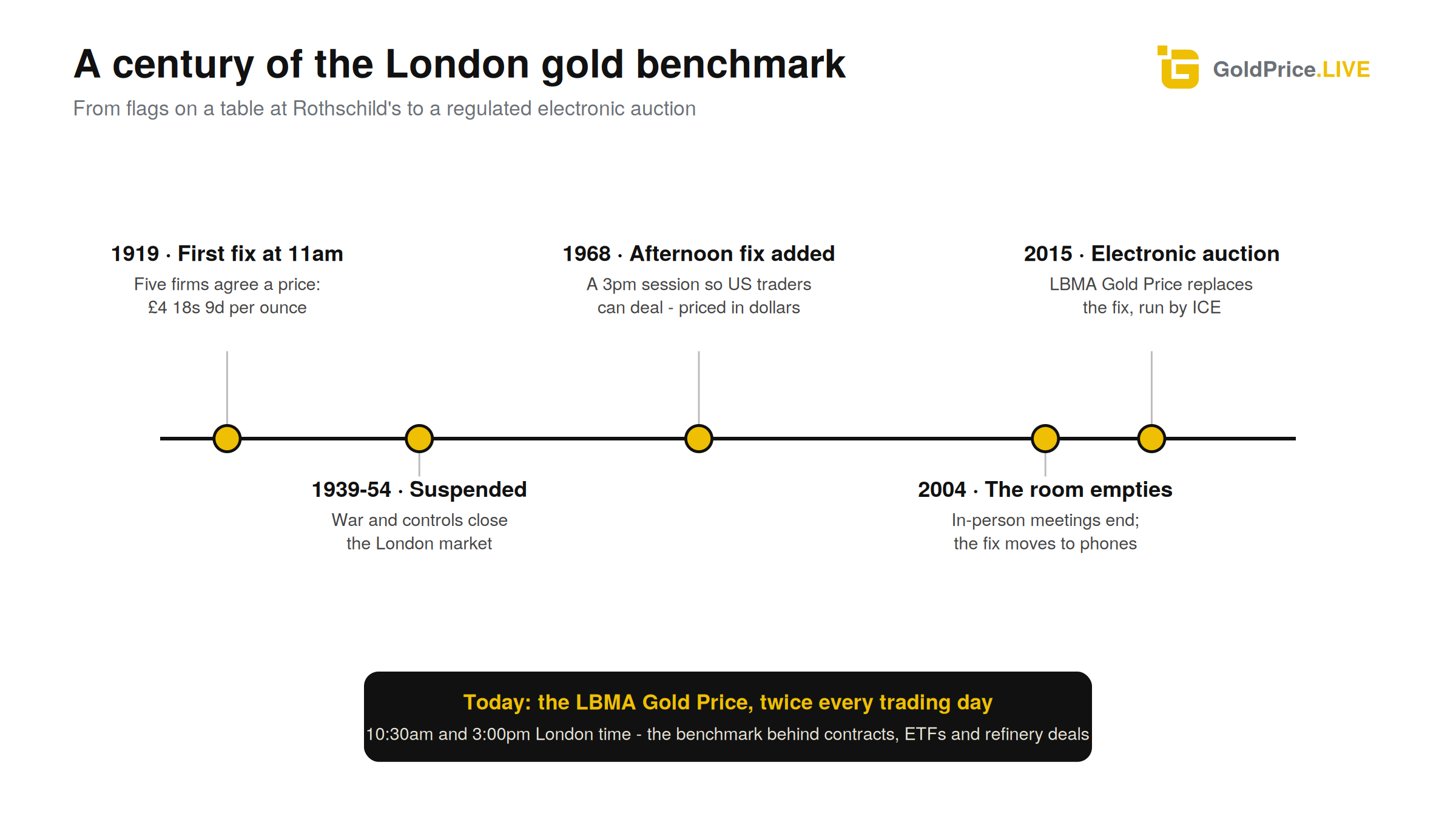 From flags on a table at Rothschild's to a regulated electronic auction: a century of the London benchmark.
Open a dealing screen and you won't see one gold price. You'll see two.
The bid is what buyers are willing to pay. The ask (or offer) is what sellers are willing to accept. The gap between them is the spread, and the spot price you see quoted is typically the midpoint or the last traded price between the two.
For wholesale gold, the spread is razor thin, often well under a dollar an ounce on a $4,000+ metal. That tightness tells you how liquid gold really is. Compare that with the spread on a house, a used car or a rare stamp and you'll appreciate how efficiently gold trades.
For you and me at the retail level, the spread is wider. A dealer might sell you a one ounce coin at spot plus 4 percent and buy it back at spot or slightly under. That gap covers their costs and risk. It's also why gold rewards patience: if you're trading in and out every fortnight, the spread will eat you alive, whereas a long-term holder barely notices it. Understand the difference between bid, ask and spot and you'll never be surprised by a dealer's quote again.
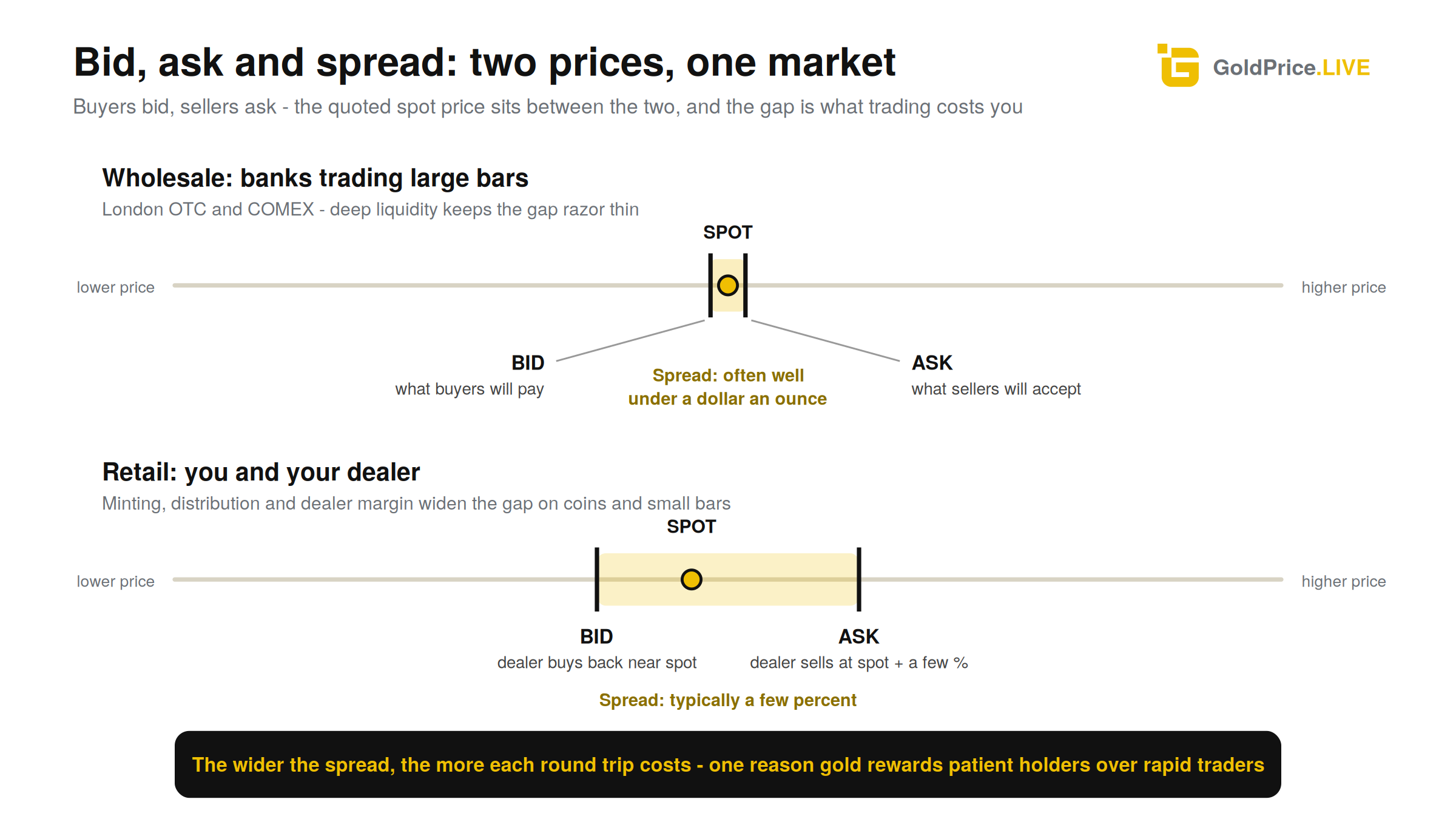 Wholesale spreads are pennies; retail spreads are percent - the gap is the true cost of each trade.
Here's a question I get constantly: if gold is a global market, why is the price different in India, or China, or down at my local dealer?
Four reasons, and they stack on top of each other.
Currency. The dollar price is universal; your local price isn't. If gold is flat in dollars but the pound falls 2 percent against the dollar, gold just rose 2 percent in sterling. This is why gold can quietly hit record highs in one currency after another even when the dollar chart looks unremarkable. It's also why gold is such a useful hedge against weakness in your own currency, wherever you happen to live.
Taxes and duties. India, one of the world's great gold-consuming nations, levies import duty plus GST on gold, so the street price in Mumbai sits meaningfully above the international price. In the UK, investment gold has been VAT-free since 2000, and certain coins like Sovereigns and Britannias are exempt from capital gains tax for UK residents, which affects what buyers will pay for them. Tax policy shapes local prices everywhere.
Local supply and demand. Physical gold in Shanghai often trades at a premium to London, and sometimes at a discount, depending on Chinese demand and import quotas. Indian dealers swing between premiums and discounts around the wedding and festival seasons. These local premiums are a genuine second layer of price discovery, telling you where in the world the metal is actually being pulled.
Retail premiums. Finally, the product itself. A one ounce coin costs more per ounce than a kilo bar because minting coins costs money. Popular coins carry higher premiums than generic rounds. In moments of panic buying, retail premiums can blow out dramatically even while the spot price falls, as anyone who tried to buy coins in March 2020 will remember.
So when you compare the price on your screen with the price in a shop window in Dubai or Delhi, you're not looking at a broken market. It's one global price wearing different local clothes.
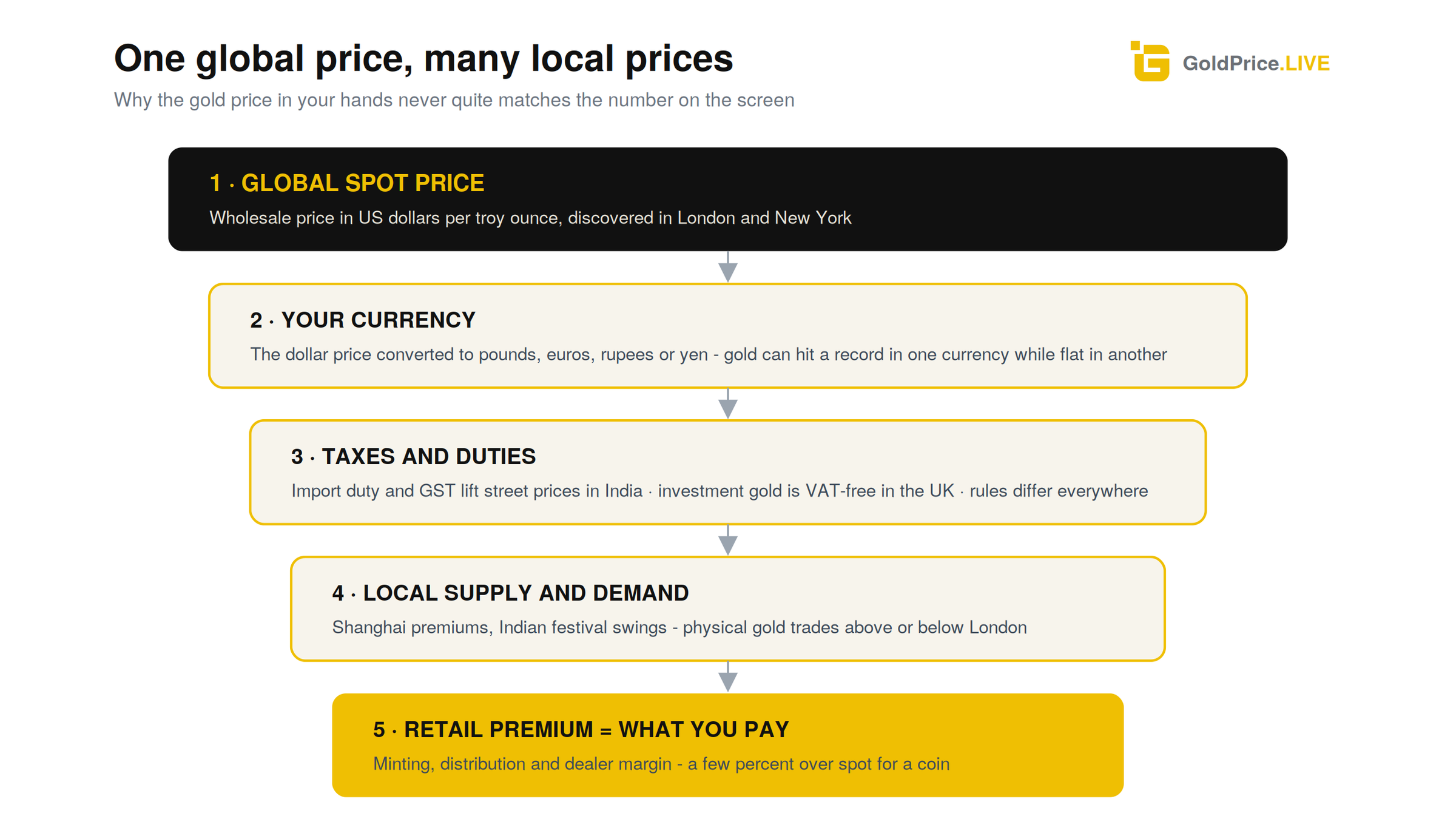 Five layers sit between the wholesale spot price and the price you actually pay for a coin.
The gold price, then, is best understood as a layered thing. At the core sits the wholesale spot price, discovered continuously through London OTC trading and COMEX futures, anchored twice a day by the LBMA Gold Price auction. On top come the currency conversions, taxes, local premiums and dealer spreads that determine what gold actually costs in your hands, in your country, today.
None of it is arbitrary, and none of it is controlled by any single party. That's rather the point of gold. It's one of the few assets on earth whose price emerges from a genuinely global, round-the-clock negotiation between millions of participants, from the People's Bank of China down to a first-time buyer picking up a tenth-ounce coin.
Once you understand where the number comes from, the daily noise gets easier to read. A move in the dollar, a central bank announcement, a shift in COMEX positioning, a spike in Asian premiums: each leaves its fingerprints on the price in a slightly different way. That's what we track every day here at GoldPrice.Live, and it's what my four years running the Theseus research project taught me to respect. The price is the market's verdict, updated every second. Learn to read it and you're halfway to understanding gold itself.
Founder of GoldPrice.Live and GoldBuzz.com. Passionate about gold and silver. Designed the 4-year Theseus research project. Ex-British Aerospace and Scotland Yard, now based in Canada.
