


 By Rick Adams•September 30, 2026
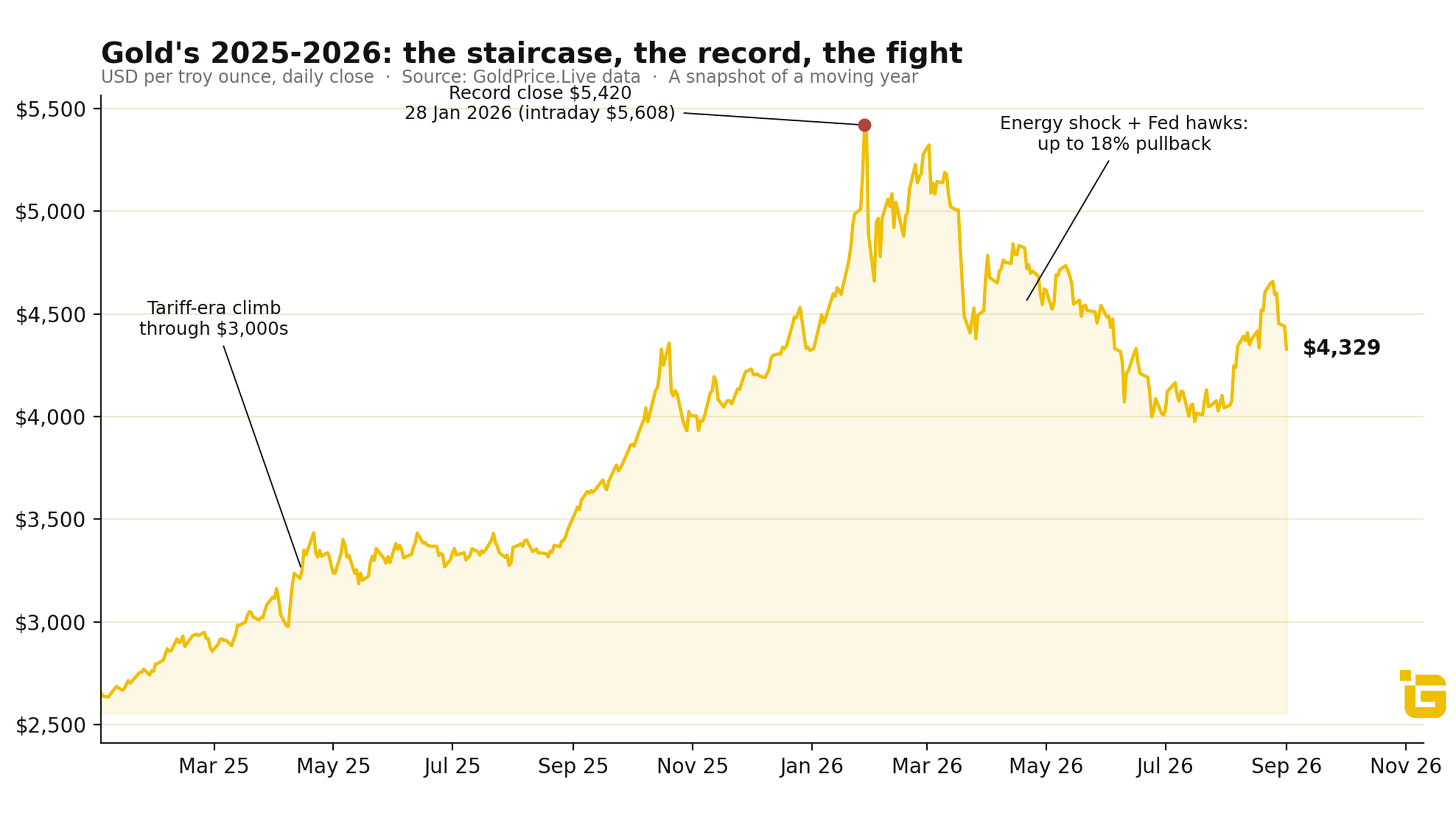
What a year to be watching gold. January brought an all-time high near $5,600 an ounce. By spring the metal had surrendered as much as 18 percent of it. August delivered the best week since January, promptly followed by the sharpest daily fall in months when the Federal Reserve chairman cleared his throat at Jackson Hole. If you've come here trying to understand the factors affecting gold price 2026 has thrown at us, you've picked a year with no shortage of material.
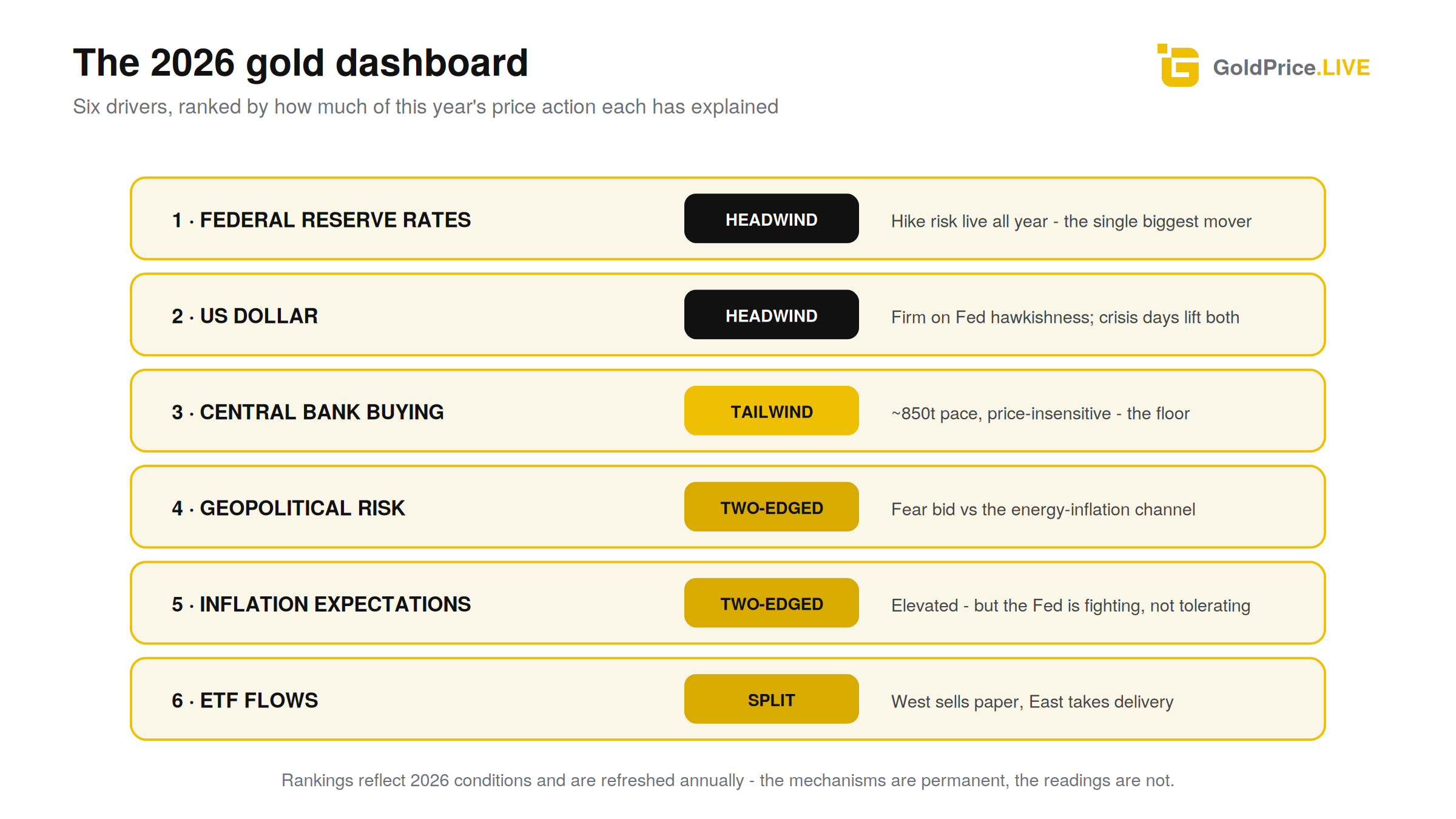
The good news is that beneath the drama, the same handful of forces are doing all the work - and once you can name them, this year's whipsaw starts to make sense. I've written elsewhere about what moves gold price in any year; this piece is about how those forces are actually lining up right now, in 2026, and which ones deserve most of your attention. Here are the six gold price drivers 2026 has put in charge, roughly in order of influence.
A word on that ranking before we start. Gold market factors don't act one at a time; they gang up, cancel out and occasionally swap sides mid-year. The ordering below reflects how much of 2026's actual price movement each has explained so far - which is a judgement, not a law of physics - and the most instructive moments of the year have been precisely the ones where two heavyweight factors pulled in opposite directions. Keep that in mind whenever a neat single-cause explanation of a gold move is offered to you, including by me.
1. Federal Reserve rates: the hand on the tiller
Every year the Fed matters to gold. In 2026 it has been the whole weather system.
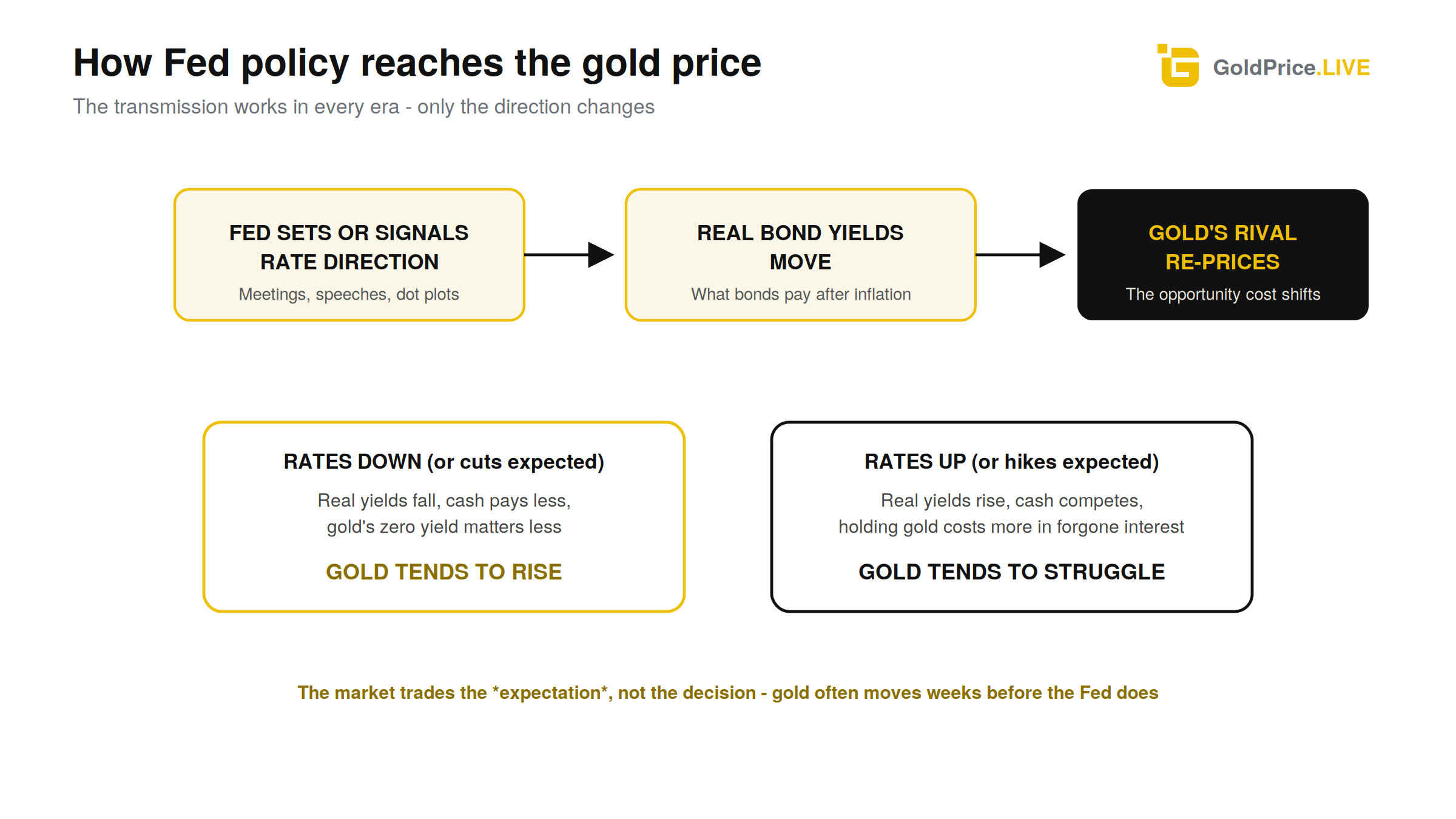
The reason is mechanical. Gold pays no interest, so its stiffest competition is the yield on cash and government bonds. When Federal Reserve rates rise, or markets expect them to, the opportunity cost of holding gold climbs and the price tends to sag. When rate expectations fall, gold breathes again.
What makes 2026 unusual is the direction of travel. After years in which markets debated how fast rates would fall, this year's question has been whether they need to rise again. Under Chairman Kevin Warsh, the Fed has struck a persistently hawkish note, and his message at the Jackson Hole symposium in August - that policymakers may need to do more if inflation doesn't return to target - knocked more than 3 percent off gold in a single session. Markets have spent late summer pricing a September hike as more likely than not, with the odds swinging violently on every payrolls report and inflation print.
That swing is the 2026 gold chart in miniature. Tame inflation data pushes hike odds down and gold up; hawkish speeches and hot energy prices do the reverse. The dance happens several times a month: a payrolls Friday, an inflation Wednesday, a Fed press conference, each one repricing the odds and dragging gold with it, sometimes by 2 or 3 percent in a session. If you follow only one input for the rest of the year, make it the market's rate expectations - they've been the single most reliable explanation of gold's weekly moves all year.
2. The US dollar: the old seesaw, still creaking
Gold's inverse relationship with the dollar is the most durable habit in the market, and 2026 hasn't broken it - though it has complicated it.
The mechanics are familiar to regular readers: gold is priced in dollars, so a stronger dollar makes it dearer everywhere else, trimming demand at the margin. This year the dollar has drawn strength from two directions at once - the Fed's hawkish tilt and, at moments of Middle East escalation, its own safe-haven bid. That second effect produces the confusing days when gold and the dollar rise together: frightened money buying both shelters at once.
The practical guidance stands: when gold has moved and nothing else explains it, check the dollar index first. In 2026, more often than not, that's where the answer has been hiding.
3. Central bank buying: the floor under the market
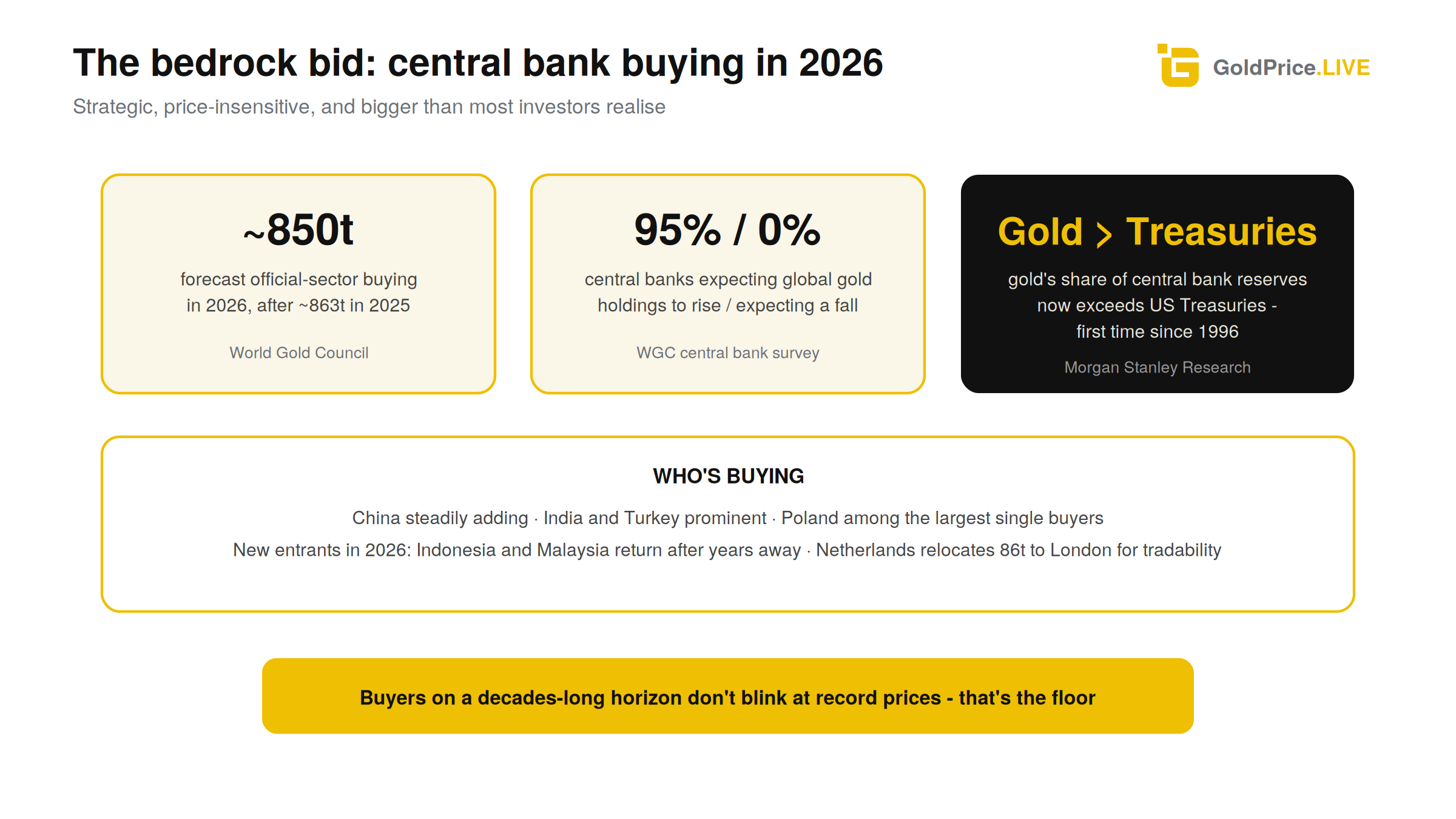
If the Fed has been 2026's weather, central bank buying has been its bedrock - and it's the factor I'd nominate as the most underappreciated by casual observers.
The official sector bought roughly 863 tonnes of gold in 2025, and the World Gold Council forecasts a similar order of magnitude - around 850 tonnes - for 2026. China has kept adding steadily to reserves, India and Turkey remain prominent accumulators, Poland has been among the largest single buyers, and a striking 2026 development has been new entrants: central banks such as Indonesia's and Malaysia's, absent from the market for years, have started buying. The World Gold Council's most recent central bank survey found 95 percent of respondents expecting global official gold holdings to keep rising - and not a single one expecting a decline.
Why it matters for price: this demand is strategic, not tactical. Central banks are diversifying away from dollar assets in response to sanctions risk, debt worries and geopolitical fragmentation, and they buy on a horizon of decades. They didn't blink at January's record prices. That consistent, price-insensitive bid is a large part of why gold's 2026 corrections, sharp as they've felt, have kept finding buyers. One milestone captures the shift: by Morgan Stanley's reckoning, gold now makes up a larger share of global central bank reserves than US Treasuries - the first time that's been true since 1996.
A related 2026 subplot is worth a line: it's not only about buying, but about where the metal sits. The Dutch central bank disclosed this year that it had moved 86 tonnes of its gold from New York and Ottawa to London to improve tradability. Repatriations and relocations of reserves have quietly accelerated across the official sector, and they tell the same story as the purchases: central banks want their gold closer, more liquid and more surely theirs.
4. Geopolitical risk: the year's wild card
Gold has been a crisis hedge for as long as there have been crises, but 2026 has given the old reflex an unusually stern workout.
It helps to remember the staircase gold climbed to get here, because each step had a crisis on it. The metal cleared $3,000 in the spring of 2025 amid the tariff upheaval, passed $4,000 during the prolonged US government shutdown later that year, and sprinted to January 2026's record as Middle East tensions and heavy investment flows converged. Gold's ascent through 2025 and 2026 reads like a ledger of the world's worries, which is exactly what it is.
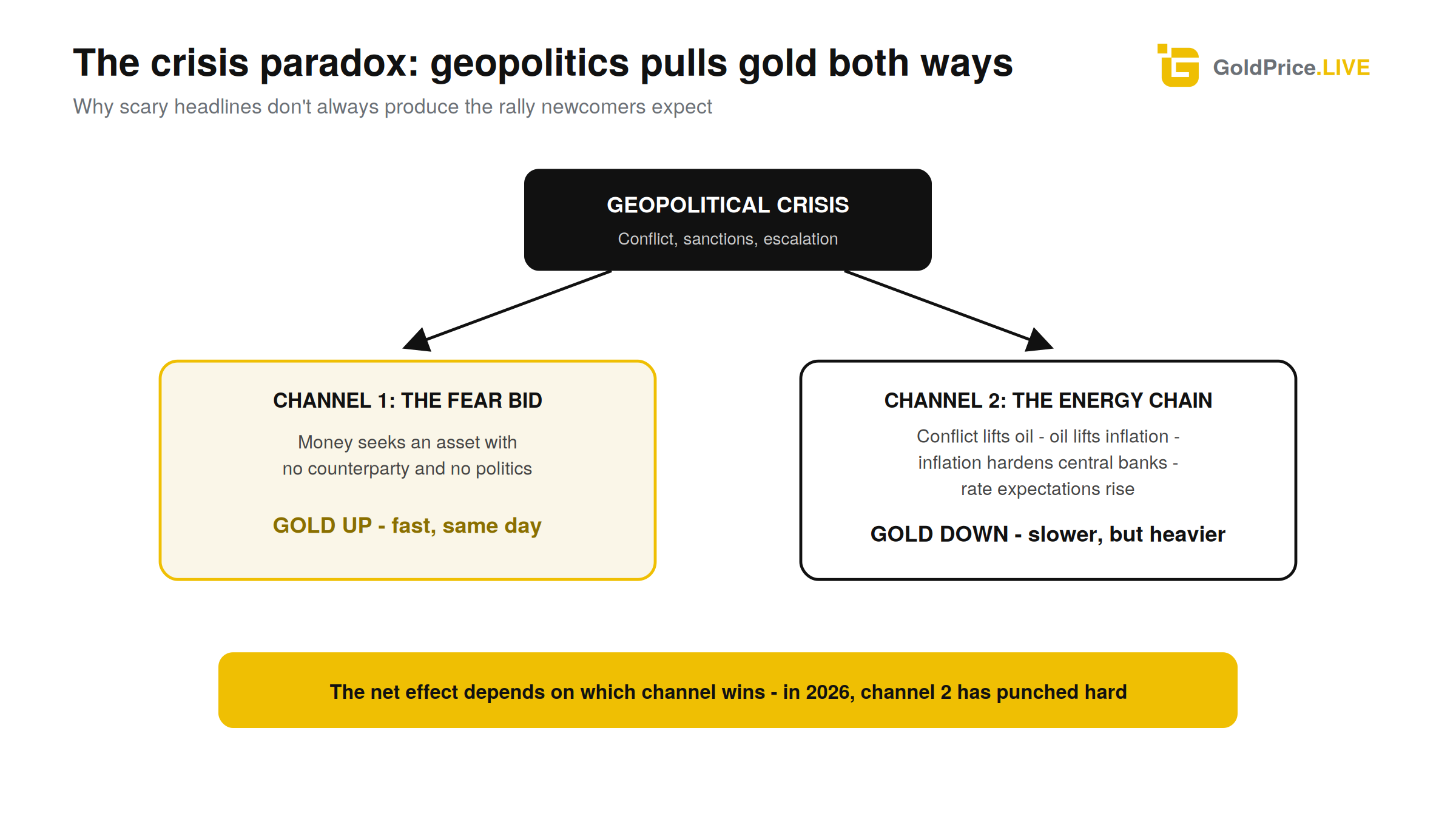
The year's dominant flashpoint has been the Middle East, where confrontation between the United States and Iran escalated into direct strikes and retaliation. Each escalation has done two things to gold at once. The first is the classic safe-haven bid: money seeking an asset with no counterparty when the world looks dangerous. The second is subtler and, this year, arguably more powerful: the conflict has kept oil and energy prices elevated, which feeds inflation, which hardens the Fed's hawkish stance - and that channel, perversely, hurts gold.
That's the paradox to hold in mind whenever geopolitical risk flares in 2026: gold catches the fear bid on the day, but if the crisis pushes energy costs and therefore interest rate expectations higher, the metal can end up fighting its own tailwind. It explains why some of this year's scariest headlines produced smaller gold rallies than newcomers expected. Geopolitics giveth on Tuesday and taketh away by Friday.
5. Inflation expectations: friend, then foe
"Gold is an inflation hedge" is the oldest line in the book, and over long horizons it has served well. But 2026 has been a masterclass in the line's fine print.
This year's energy shock has kept inflation expectations elevated, and in the simple version of the story that should be rocket fuel for gold. Sometimes it has been. But the market's dominant response has been to price a tougher Fed - higher rates for longer, possibly higher still - and, as covered under factor one, that raises the real yield on bonds, gold's arch-rival. With real yields holding near multi-year highs for much of 2026, Western institutional money has repeatedly judged the opportunity cost of gold too rich, whatever the inflation backdrop.
The rule of thumb that's actually worked this year: gold loves inflation that central banks tolerate, and struggles with inflation that central banks fight. In 2026 the Fed has chosen to fight. Watch the gap between inflation expectations and the Fed's response - that gap, not the inflation number itself, is what moves the metal.
6. ETF flows: the West-East tug of war
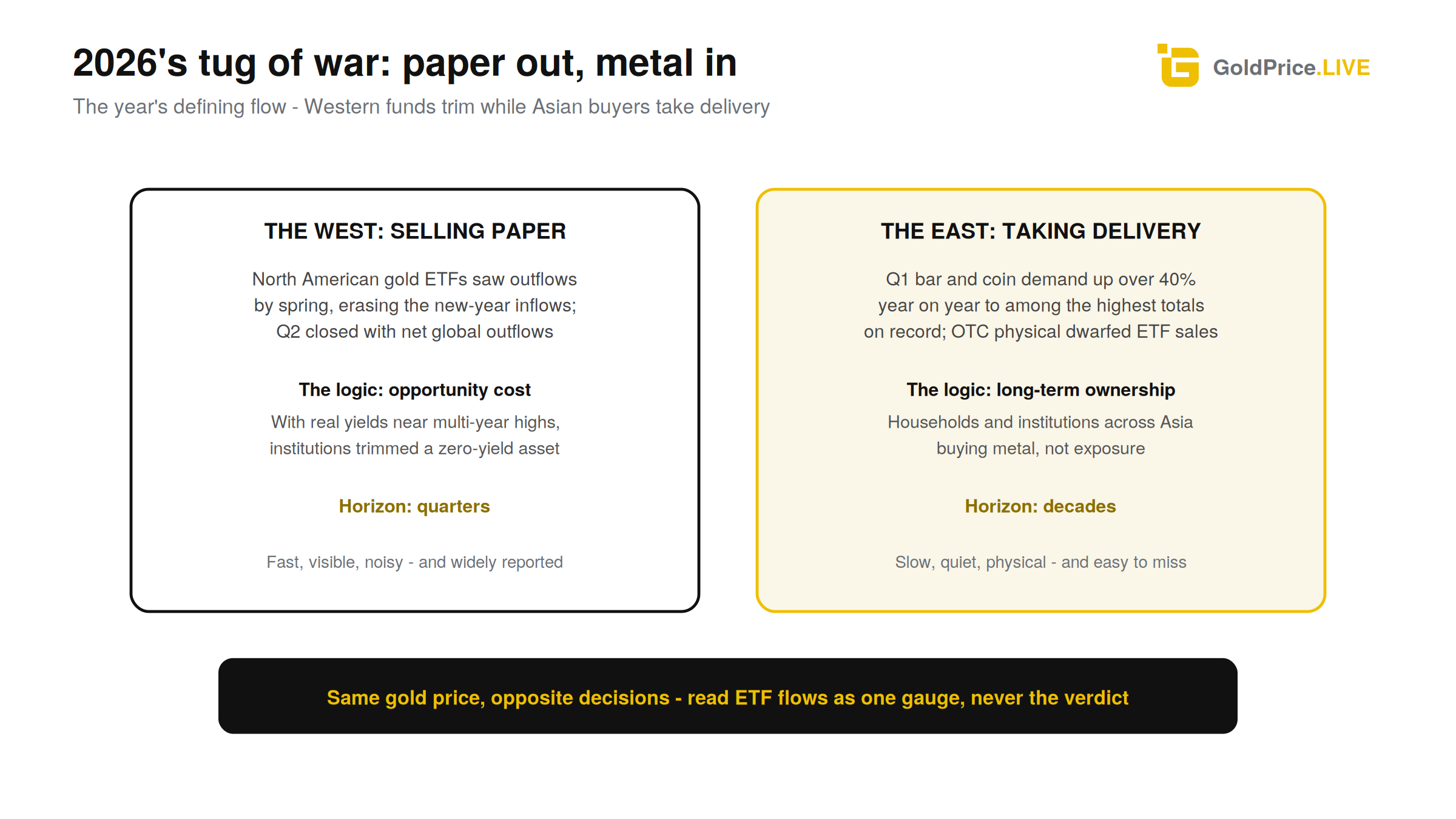
The sixth factor is the one telling 2026's most interesting story. Gold exchange-traded funds - the paper wrapper through which Western institutions mostly hold the metal - began the year with heavy inflows as prices sprinted to the record. Then the mood turned: by spring, North American funds were bleeding, with outflows in some months large enough to erase the start-of-year accumulation, and the second quarter closed with net global outflows.
Ordinarily that would be a grim signal. What's made 2026 different is who has been standing on the other side of the trade. Asian physical demand has run at extraordinary levels - bar and coin buying in the first quarter surged more than 40 percent year on year to some of the highest totals on record, and over-the-counter physical purchases by Asian institutions and family offices have dwarfed the ETF outflows. The West has been selling gold's paper form on opportunity-cost arithmetic; the East has been taking delivery of the metal itself on a much longer view.
For price watchers, the lesson is to read ETF flows as one gauge among several rather than the verdict. They capture Western institutional sentiment quickly and noisily. They entirely miss the physical tide running the other way.
1. Federal Reserve rates - Headwind, with hike risk live all year. Watch rate expectations around each Fed meeting and inflation print.
2. US dollar - Mostly a headwind, with crisis-day exceptions. Watch the dollar index, especially after Fed communications.
3. Central bank buying - Steady tailwind, price-insensitive. Watch WGC quarterly demand reports and new buyer announcements.
4. Geopolitical risk - Two-edged: fear bid versus the energy-inflation channel. Watch Middle East escalation and the oil price response.
5. Inflation expectations - Cuts both ways via the Fed's reaction. Watch the gap between inflation data and Fed rhetoric.
6. ETF flows - Western outflows offset by Asian physical demand. Watch monthly ETF flow data against WGC physical figures.
A postscript for readers holding gold in pounds: sterling adds its own layer to all six factors. UK holders experienced 2026's dollar-gold turbulence through the dollar-sterling rate, which has at times cushioned the falls and at times muted the rallies. As ever, the sterling chart - not the dollar one - is the true record of what a British holding has done, and it's worth judging your own position in your own currency before reacting to dollar-denominated headlines.
Six forces, one price - and a year that has tested every one of them, sometimes all in the same week. The 2026 pattern in a sentence: relentless official-sector and Asian physical buying has been holding the floor, while the Fed's inflation fight and a firm dollar have kept pressing on the ceiling, with geopolitics rattling the walls in between. However the rest of the year resolves, you now know which dials to watch - and when 2027 arrives with its own cast of characters, the dials themselves won't have changed, only the readings.
Founder of GoldPrice.Live and GoldBuzz.com. Passionate about gold and silver. Designed the 4-year Theseus research project. Ex-British Aerospace and Scotland Yard, now based in Canada.