


 By Rick Adams•September 30, 2026
People often imagine there's a formula somewhere - a spreadsheet in a Swiss basement that spits out the gold price each morning. When readers ask me how the gold price is calculated, that's usually what they're picturing: inputs in, a number out.
The truth is more interesting, and it comes in two halves. The headline price itself isn't calculated at all - it's discovered, through an auction in London and a torrent of trading in New York, because no formula on earth can tell you what millions of buyers and sellers are willing to pay. But everything downstream of that number genuinely is calculated: the price per gram on an Indian jeweller's board, the sterling quote on a UK dealer's site, the value of your grandmother's 18 karat bracelet. Those all come from plain arithmetic applied to the discovered price - divisions, multiplications and purity factors that anyone can check with a pocket calculator.
This article covers both halves: how the world discovers the number, and then the actual formulas that turn it into every other gold price you'll ever meet. By the end you'll be able to reconstruct any gold quote on the planet from first principles, which is a quietly satisfying party trick.
How is gold price set? The London auction, up close
I've written before about who sets the gold price in broad strokes. This time let's put the London mechanism under the microscope, because it's a small marvel of design.
Twice every trading day, at 10:30am and 3:00pm London time, ICE Benchmark Administration runs the LBMA Gold Price auction. It works in rounds of 30 seconds. At the start of each round, the system publishes a price. Participants - the big bullion banks, carrying orders for miners, refiners, funds and their own books - then have those 30 seconds to enter how much gold they'd buy or sell at that price, down to a minimum order of a single ounce. There's even a "Round Zero" beforehand: a half-hour window where participants can queue their orders before the action starts.
When the round ends, the system totals the buying and selling. If the two sides differ by more than 10,000 ounces, the price wasn't right: it adjusts - up if buyers dominated, down if sellers did - and a new 30-second round begins. Orders carry over, and participants can amend them as the price moves. The moment the imbalance falls within the 10,000 ounce threshold, the auction completes, everything trades at that final price, and any small leftover imbalance is shared equally among the direct participants so nobody games the last round.
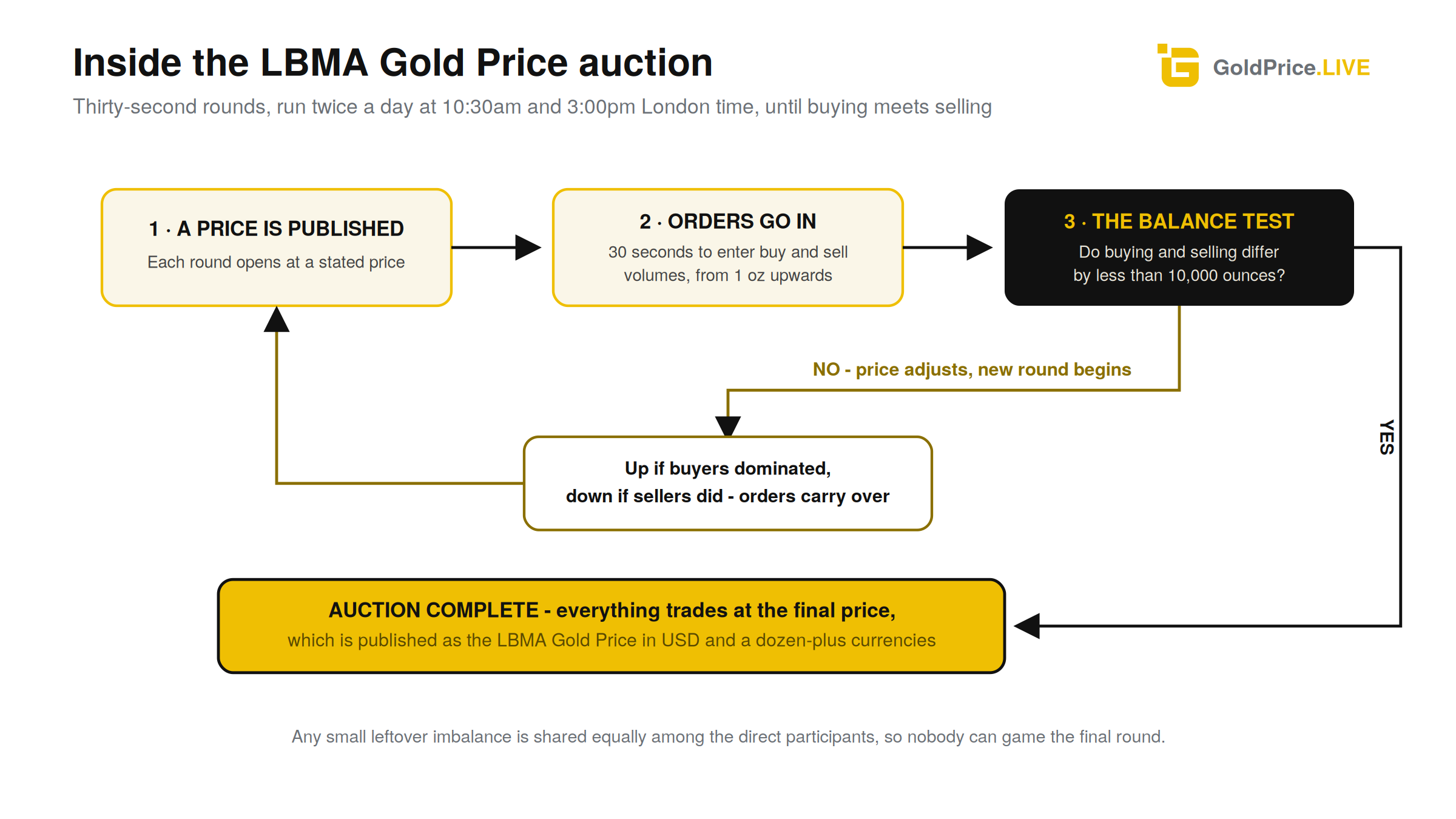 That final figure is published as the LBMA Gold Price. The price formation happens in US dollars, and it's then converted and published in more than a dozen currencies, from sterling and euros to rupees, yen and yuan. Notice the philosophy: the benchmark is a by-product of real trades, not a committee's opinion. The auction finds the price at which actual buying equals actual selling, which is the only definition of "the right price" a market ever offers.
The COMEX contribution: pricing between the auctions
Two auction prints a day can't serve a market that never sleeps, and this is where New York comes in. COMEX gold futures trade almost around the clock, and the front-month contract - the nearest, most actively traded delivery date - is the reference the world's live price feeds lean on most heavily during US hours, blended with London's continuous over-the-counter dealing the rest of the time.
Each COMEX contract covers 100 troy ounces, and activity concentrates in a handful of delivery months, with traders rolling from one to the next as expiry approaches. That concentration is exactly what makes the front month useful as a reference: it's where the most opinions collide per second, so its price digests new information faster than anywhere else. When an inflation figure lands or a central banker clears his throat, the futures price reacts within moments, and the world's spot quotes follow it like iron filings after a magnet.
Arbitrage stitches the two together. If futures drift meaningfully above the price of actual London metal plus carrying costs, traders sell futures and buy metal until the gap closes, and vice versa. So although nobody "calculates" the live spot price you see ticking on GoldPrice.Live, it's continuously disciplined from both sides - anchored twice daily by the London auction, and kept in line minute to minute by New York's futures. Think of the auction as the tuning fork and the futures market as the orchestra playing between strikes.
 The gold price formula: from USD spot to your local price
Now for the half that really is arithmetic. Every local gold price in the world derives from the dollar spot price through the same chain, and it's worth learning because it demystifies every quote you'll ever see.
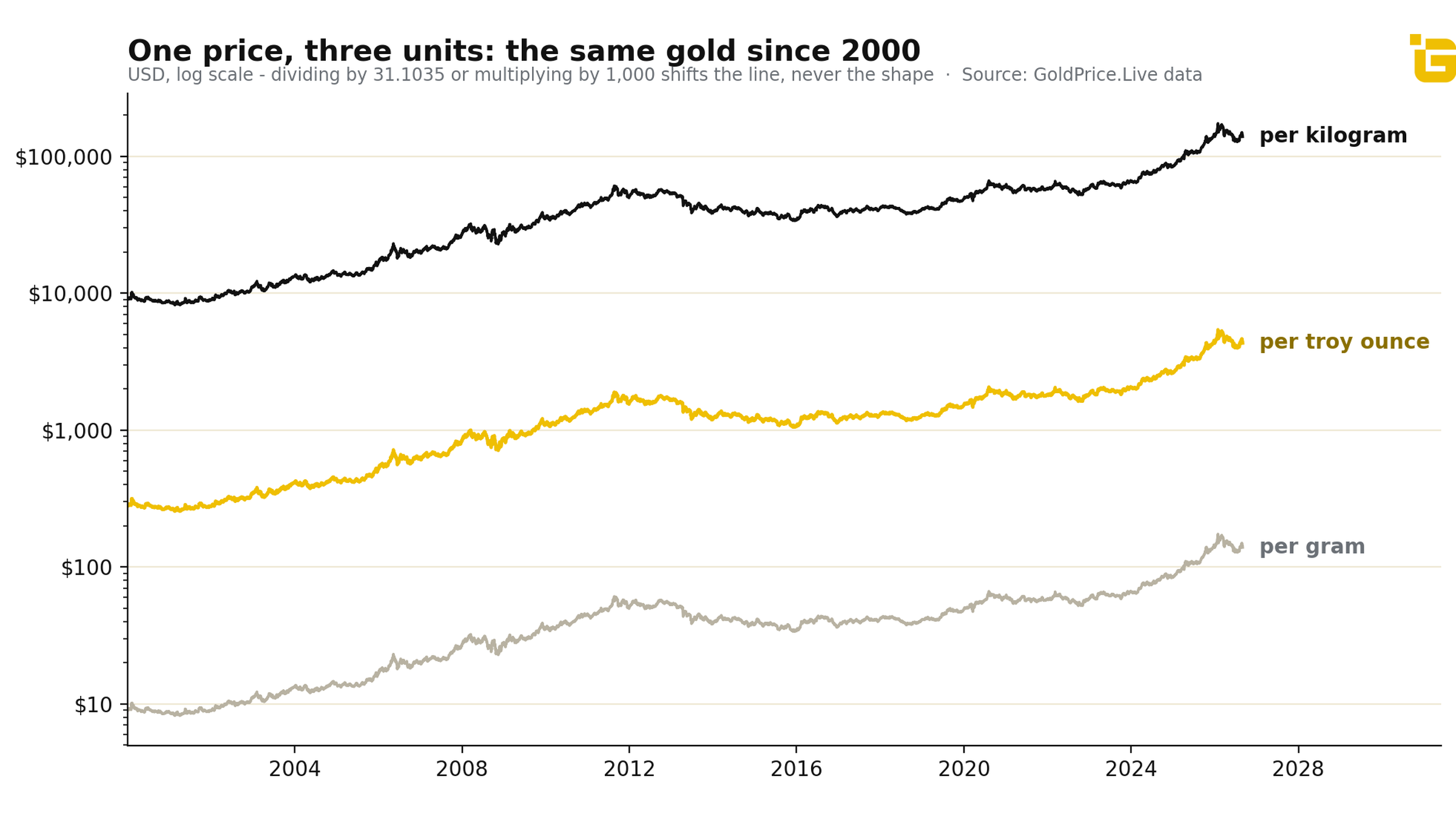
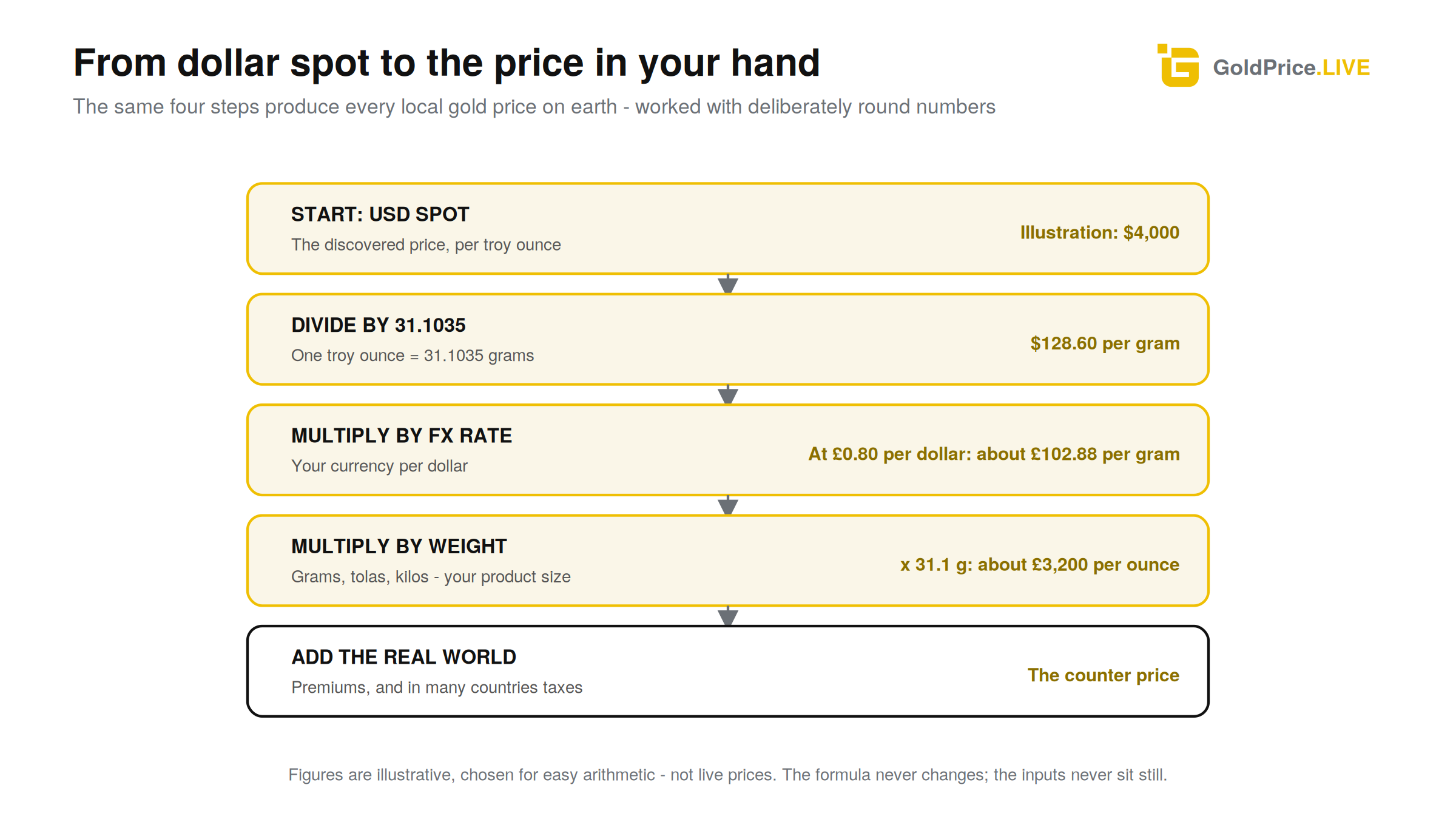
Start with the only conversion constant that matters in this business: one troy ounce equals 31.1035 grams. The troy ounce calculation gives you the per-gram price the rest of the world works in:
Price per gram = USD spot price ÷ 31.1035
Then currency conversion brings it home:
Local price per gram = (USD spot ÷ 31.1035) × your currency per dollar
Let's run it with deliberately round numbers. Suppose spot stands at $4,000 per troy ounce and one dollar buys £0.80 - which is the same as saying £1 buys $1.25. Then gold costs $4,000 ÷ 31.1035 = $128.60 per gram, and $128.60 × 0.80 = £102.88 per gram, or about £3,200 per ounce. Mind the direction of the exchange rate: quotes come both ways round, and using the wrong one gives an answer too silly to miss.
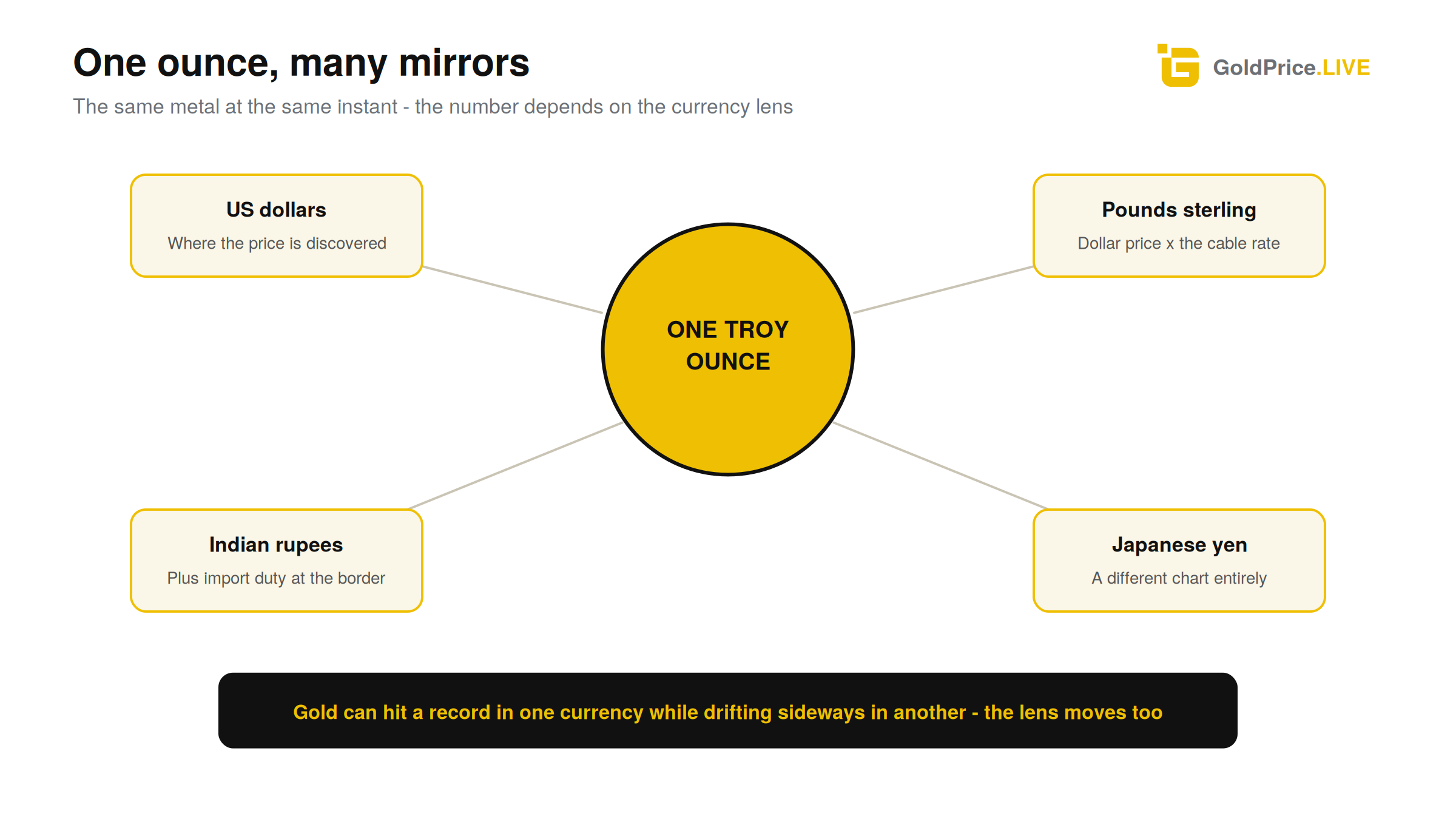
 An Indian jeweller runs the identical chain through rupees; a Japanese dealer through yen. Same metal, same formula, different final leg.
Two footnotes complete the picture. First, weights: multiply the per-gram figure by 10 for a 10 gram bar, by 1,000 for a kilo, by 11.66 for an Indian tola. Second, the real world adds its slice after the maths: premiums, and in many countries taxes, sit on top of the calculated figure.
While we're on units, it's worth knowing the local dialects, because gold arithmetic sounds different around the world even when the formula is identical. American scrap dealers still quote in pennyweights - twenty to the troy ounce, so each is 1.555 grams - a unit that survives almost nowhere else. South Asia runs on the tola of 11.66 grams, which is why Indian and Pakistani bars come in ten-tola sizes. Hong Kong's jewellery trade uses the tael, a little over 37 grams. And the professional market itself never left troy ounces, for the simple reason that every contract, vault record and benchmark has been written in them for centuries and nobody fancies re-papering the world. Whatever the unit, the conversion is one multiplication away from the per-gram price, which is why I'd encourage any gold owner to think in grams: it's the Rosetta Stone of the lot. I dissected that layer in my piece on spot versus market prices, so here I'll just say the formula gets you to the wholesale doorstep; the premium walks you through it.
The purity factor: calculating by karat
The formulas above assume pure gold. Most gold in the world isn't - it's alloyed for hardness and colour - and this is where the karat system earns its keep as a calculation method rather than mere jewellery-shop vocabulary.
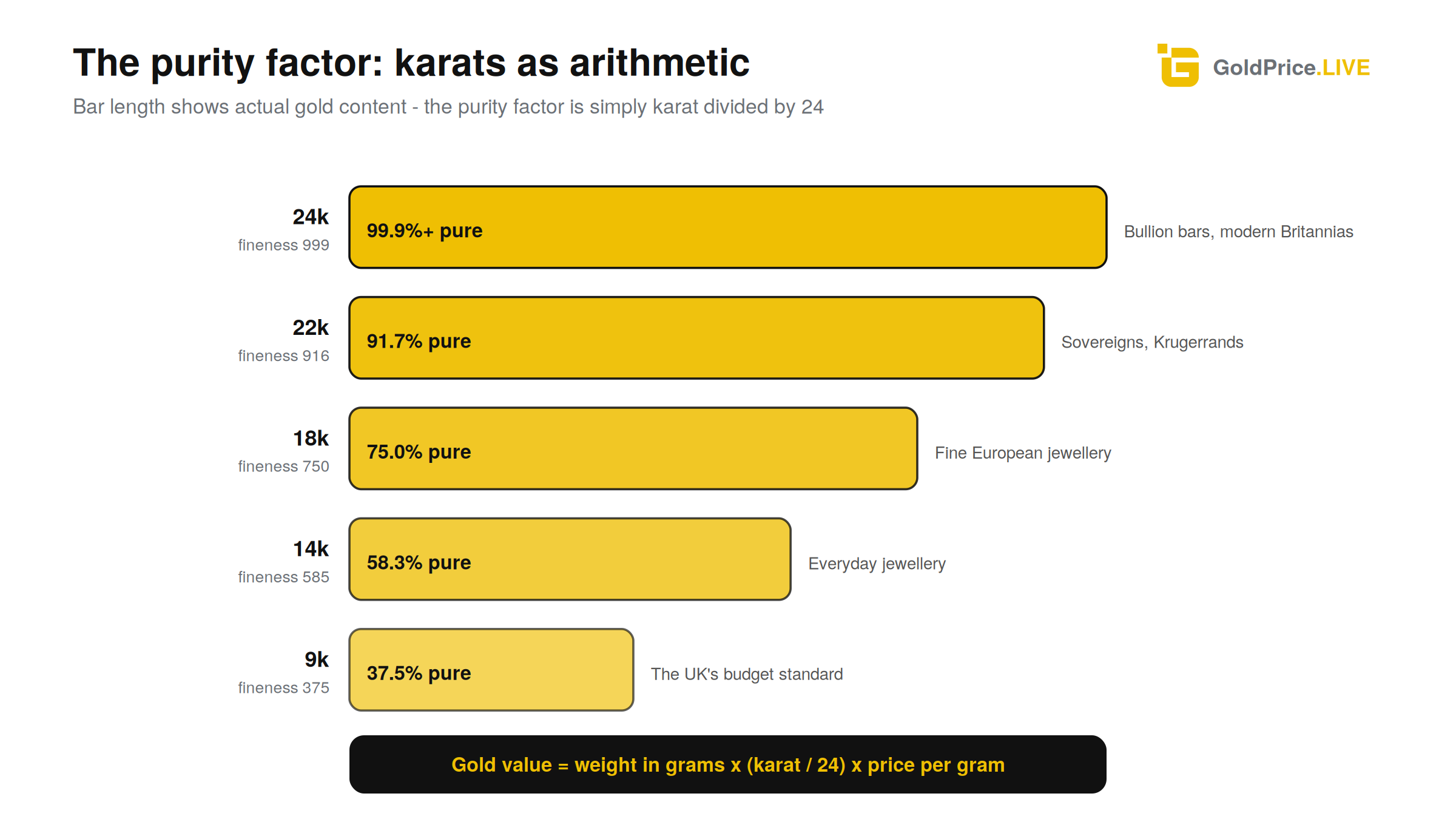
Karats measure purity in twenty-fourths. Pure gold is 24 karat. From there, the purity factor is simply karat ÷ 24:
Which gives the full gold calculation method for any object:
Gold value = weight in grams × (karat ÷ 24) × price per gram
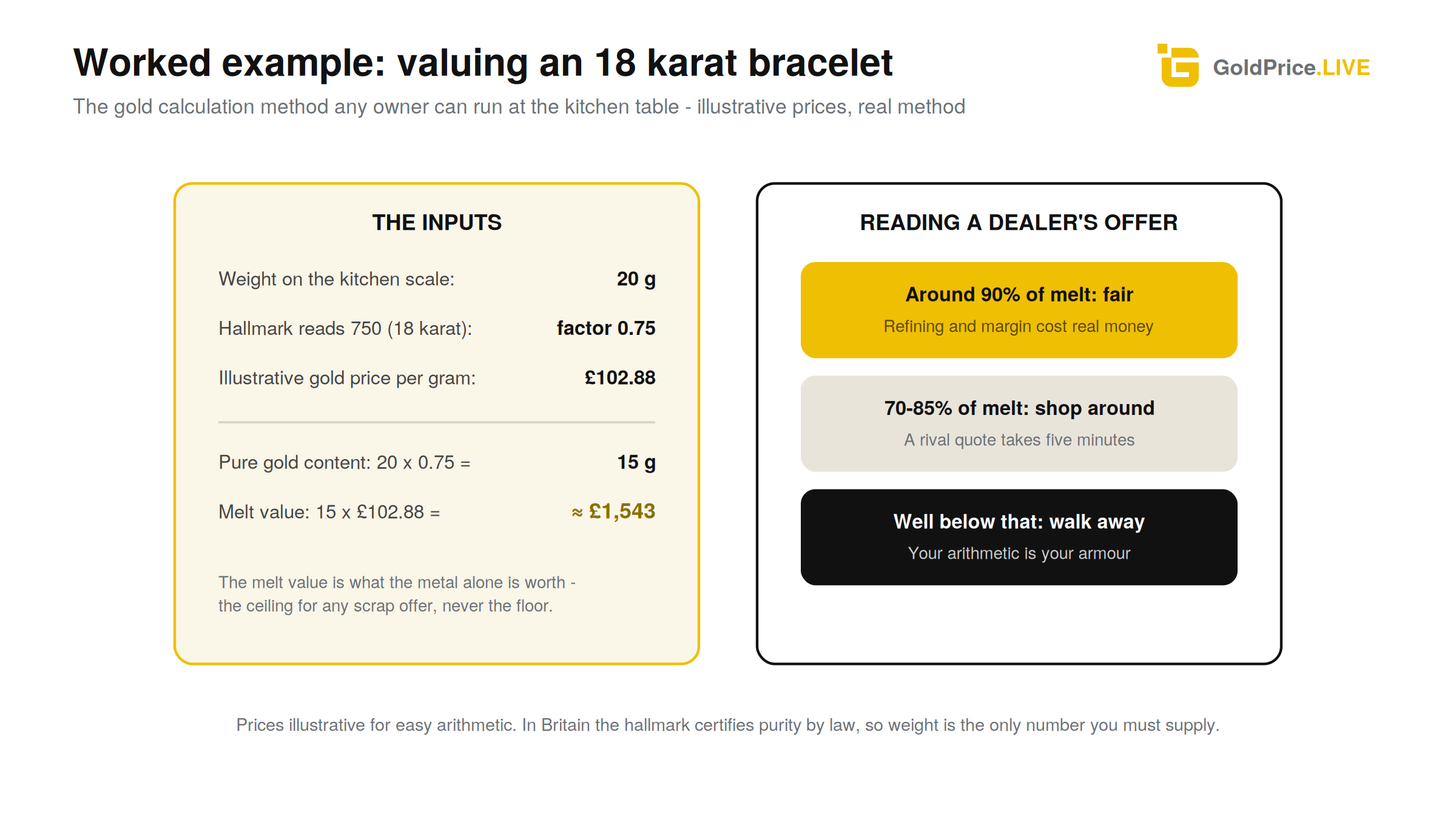
Try it on that hypothetical bracelet: 20 grams of 18 karat at our illustrative £102.88 per gram. The maths runs 20 × 0.75 × £102.88 = £1,543 of gold content. That's the melt value - what the metal alone is worth. A scrap dealer will offer somewhat less, because refining costs money and so does their margin; a figure in the region of 90 percent of melt is respectable, and well below that deserves a second opinion from a rival dealer. Hallmarks are your friend here: in Britain, the hallmark tells you the purity by law, so the only number you need to supply is the weight.
 There's a second purity language stamped on much of the world's gold: millesimal fineness, which expresses purity in parts per thousand. It maps directly onto karats - 999 or 999.9 is 24 karat, 916 is 22 karat, 750 is 18, 585 is 14, 375 is 9 - and it's what you'll usually find inside a British hallmark or on a bullion bar. If a stamp reads 750, the purity factor is simply 0.750: no karat conversion needed, the multiplier is printed on the metal. Between karats on jewellery and fineness on hallmarks and bars, virtually every piece of gold you'll ever handle declares its own factor, which makes the arithmetic pleasingly hard to get wrong.
One trap worth flagging: a 22 karat Sovereign contains exactly as much fine gold as its official specification says - the alloy adds weight, not value. When comparing coins, always compare fine gold content, not gross weight. Mints publish both figures precisely so you can.
The role of FX rates: one price, many mirrors
The last piece of the machine deserves its own section, because currency conversion isn't just the final step of the formula - it changes what the gold price means depending on where you sit.
Because price discovery happens in dollars, the gold chart your neighbour sees is your chart multiplied by an exchange rate that never stops moving. The consequences are stranger than they first appear. Gold can be flat in dollars while hitting a record in sterling, simply because the pound slipped. It can rise for an American and fall for a Japanese buyer on the very same day. During currency crises, gold priced in the stricken currency goes vertical even if the dollar price barely stirs - which is exactly why people in countries with wobbly currencies hold so much of it. Their gold isn't betting on gold; it's insurance against their own money.
A quick worked example shows the two engines meshing. Suppose over a year the dollar gold price rises 5 percent, while the pound weakens 3 percent against the dollar. A sterling holder's gain compounds both: roughly 1.05 × 1.03, or a little over 8 percent. Reverse the currency move - pound strengthens 3 percent - and the same 5 percent dollar rally shrinks to barely 2 percent in sterling. Neither holder is being cheated; they simply own gold through different windows.
For a UK holder, the practical upshot is that your gold has two engines: the dollar gold price and the dollar-sterling rate. Sometimes they pull together, sometimes they cancel out, and over the long run the sterling gold chart is the honest record of what your holding has actually done. That's why we quote prices across major currencies on GoldPrice.Live rather than making everyone squint through a dollar lens.
Put the whole machine together and the picture is rather elegant. An auction in London and a futures market in New York discover one number. A division by 31.1035, a multiplication by an exchange rate, a purity factor of karat over 24, and a premium at the counter turn that one number into every gold price on earth - from a Mumbai jeweller's board to the buyback quote on your grandmother's bracelet. No Swiss basement required. Just a market, and then arithmetic anyone can do.
Founder of GoldPrice.Live and GoldBuzz.com. Passionate about gold and silver. Designed the 4-year Theseus research project. Ex-British Aerospace and Scotland Yard, now based in Canada.