


Gold's job description, if it had one, would open with two words: inflation hedge. The phrase gets repeated so often that hardly anyone checks it. In researching this article, I checked, using the daily price history behind this site, and the gold vs inflation record turns out to be a lot more useful than I expected. Gold is a formidable hedge against one kind of inflation and a surprisingly unreliable one against another. Knowing which is which is the whole game.
The reputation isn't an accident. For most of recorded history, gold was money, and the coins in your pocket were worth what the metal in them was worth. When a ruler debased the coinage by mixing in cheaper metal, prices rose and the people holding pure gold were the ones who kept their purchasing power. Rome did it, Tudor England did it, and the lesson stuck: paper promises inflate, metal doesn't.
Then the 1970s happened. Gold went from a fixed $35 an ounce to a peak above $800 in a decade when US consumer prices doubled, and a whole generation of investors learned that gold and inflation travel together. That decade did more for gold's standing as an inflation hedge than the previous two thousand years combined.
The trouble is that one decade became the entire argument. The gold inflation hedge idea is usually quoted as if it held in every year, over every horizon, in every currency. It doesn't, and the data shows exactly where it breaks down.
Let's start with the long view, because here gold's record is excellent. I took the daily gold price series we hold at GoldPrice.Live and set it against the US Consumer Price Index (CPI), the standard measure of inflation, from the start of 1970.
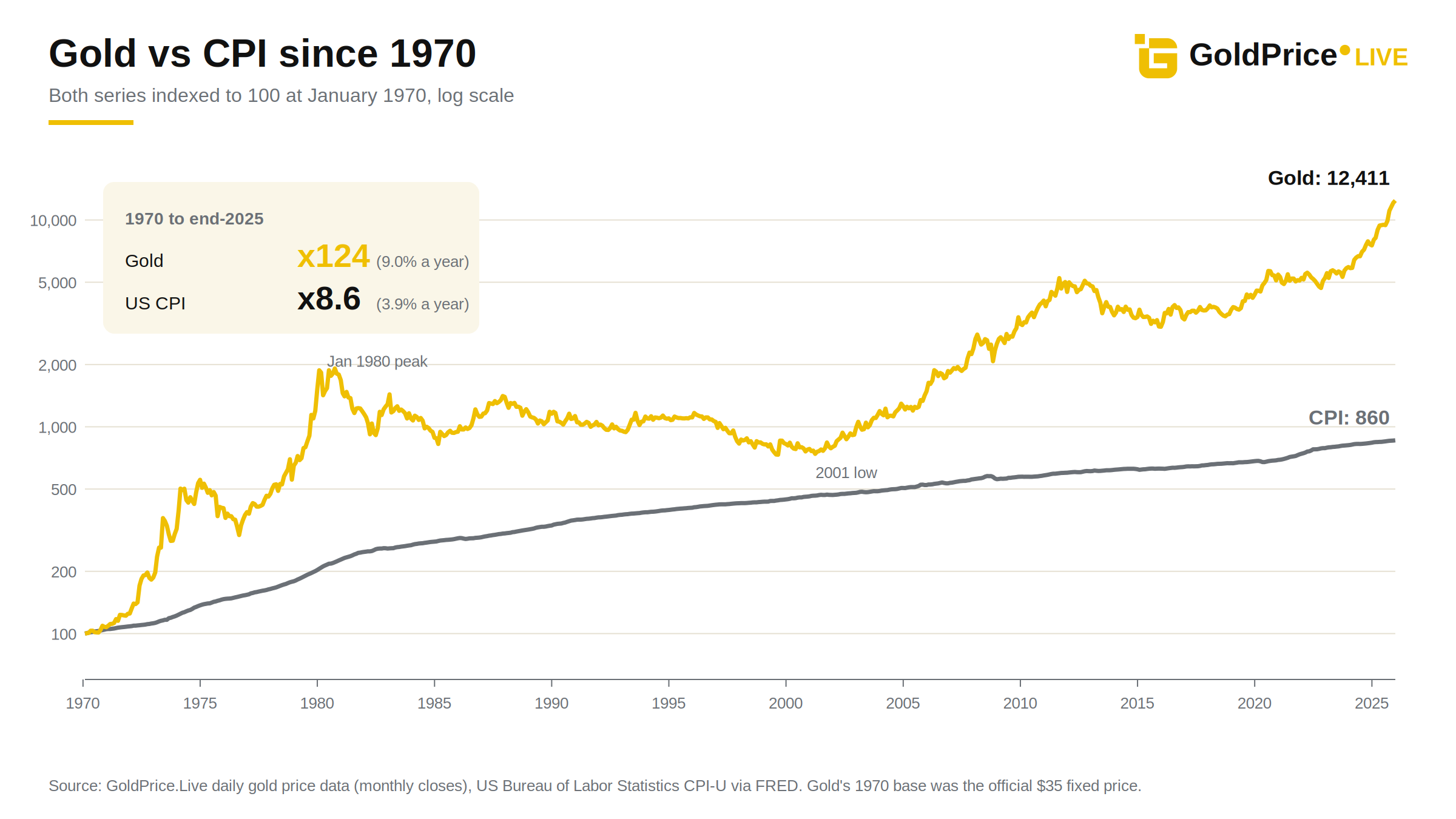
By the end of 2025, gold had risen more than 120-fold from its 1970 level. US consumer prices had risen roughly eight and a half times. Put another way, gold compounded at about 9% a year while the CPI compounded at just under 4%. A dollar's worth of gold in 1970 would buy about fourteen times as much today as a dollar left under the mattress.
I'll be fair about the starting point. In 1970 gold was still pegged at $35, an artificial price that had been held in place by governments since 1934. Measuring from a suppressed base flatters gold. So let's try it from the end of 1974, when the price was floating freely and Americans could legally own bullion again: gold rose about 22 times against a six-fold rise in the CPI. Or from the frothy top of January 1980, the worst possible month to have bought: gold still rose more than six-fold against a four-fold rise in prices. Whichever base you choose, over long stretches gold has beaten inflation comfortably.
The year-by-year picture adds a wrinkle. In the twelve calendar years since 1970 when US inflation ran above 5%, gold's average nominal return was around 23%, roughly three times its average in calmer years. High inflation years have, on average, been very good years to hold gold. The word "average" is doing a lot of work in that sentence, and the next section explains why.
If gold tracked inflation closely, you'd expect it to beat the CPI in most years. It doesn't. In our data, gold has beaten US inflation in 31 calendar years out of 56, which is barely better than a coin toss. Measured over rolling twelve-month windows the hit rate is 56%. Stretch the window to ten years and it climbs to 58%. Even over twenty-year holding periods, gold has beaten inflation in roughly two windows out of three, which means one investor in three who held for two decades still lost purchasing power.
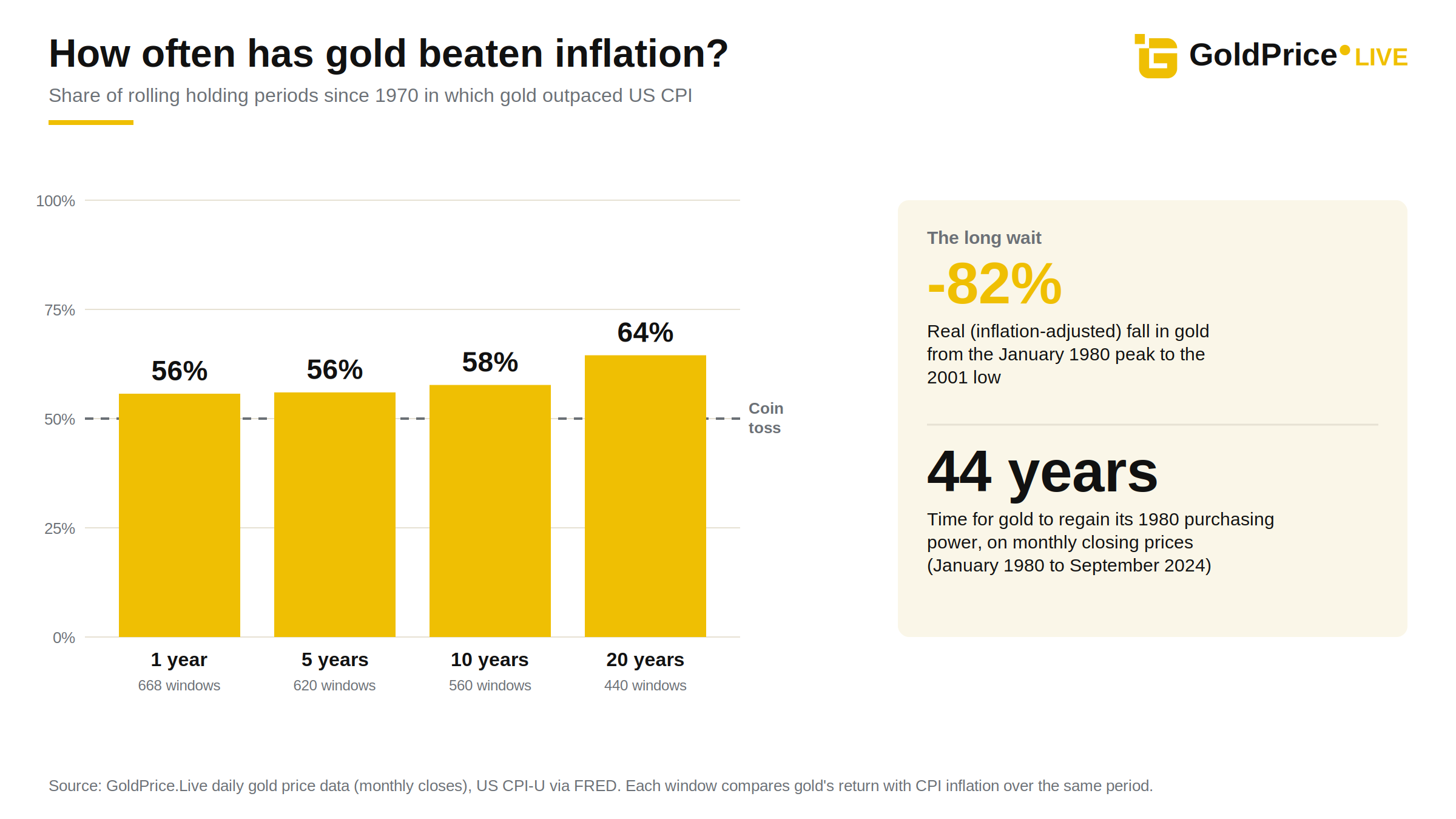
Those losing windows aren't obscure. Anyone who bought at the 1980 peak watched the real value of their gold fall by more than 80% over the next twenty-one years, with inflation grinding away at a price that was itself falling. On monthly closing prices, the inflation-adjusted January 1980 peak was not seen again until September 2024. That is forty-four years to get back to even in real terms.
The second problem is timing. Gold tends to move before inflation shows up in the data, not alongside it. The correlation between annual gold returns and the annual inflation rate since 1970 is a modest 0.42, and the price often reacts more to the fear of inflation than to the inflation itself. Gold doubled in 1979 while the headline CPI was still climbing towards its March 1980 peak of nearly 15%, then fell for most of the following year as inflation stayed in double digits. The market had already priced the problem and moved on to the cure.
Campbell Harvey and Claude Erb put numbers on this in a well-known 2013 paper, The Golden Dilemma, and reached the same conclusion: as a hedge against year-to-year changes in the cost of living, gold is unreliable. Its purchasing power swings around far too much to work as a short-term CPI tracker.
So what does gold actually respond to? The single best explanation I know is the real interest rate, which is the yield on a safe government bond minus expected inflation. Gold pays no interest, so its competition is a bond that does. When real yields are high, you give up a lot of income to hold metal. When real yields are negative, the bond holder is guaranteed to lose purchasing power and gold's lack of a coupon stops being a drawback.
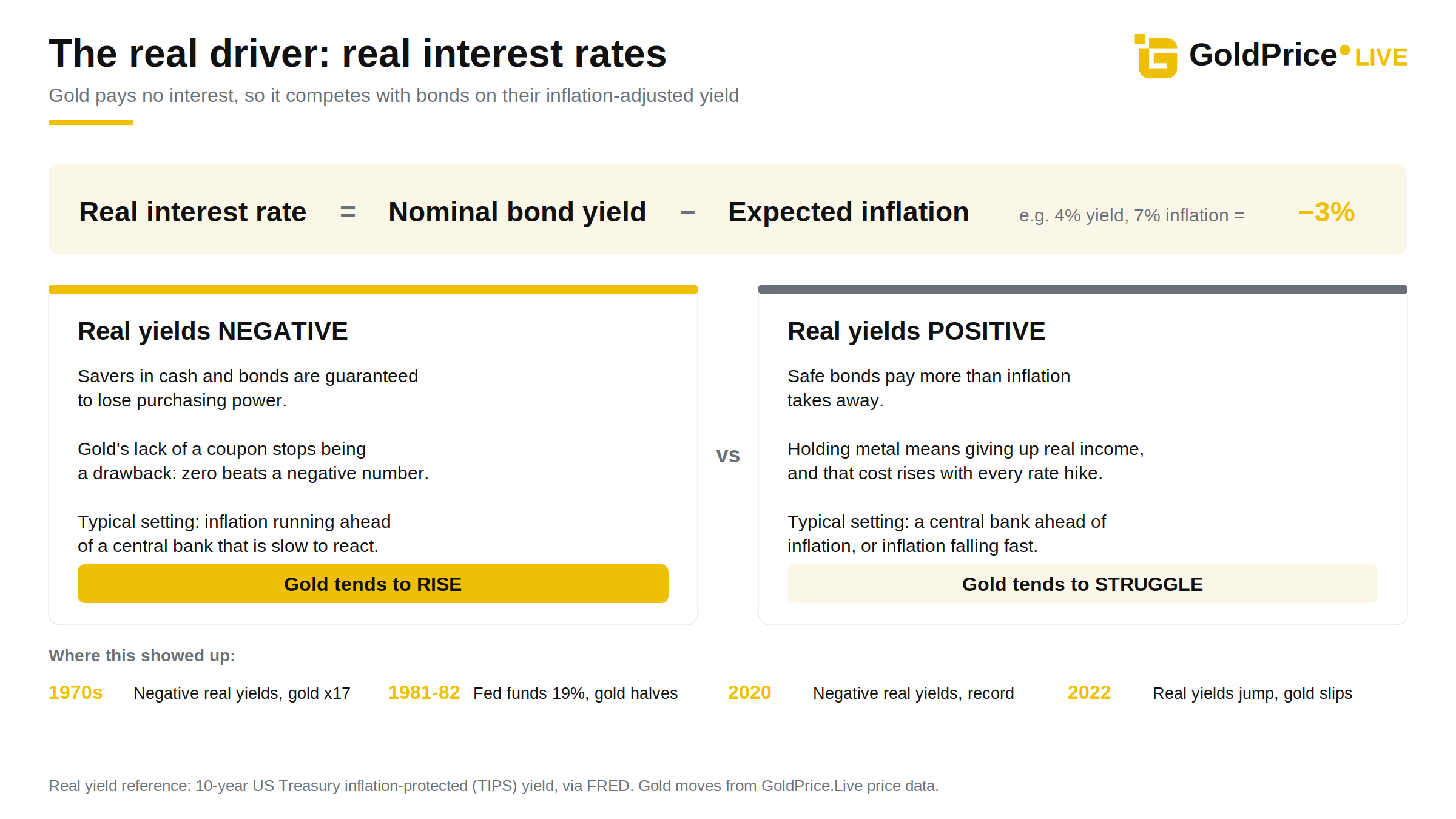
This is the mechanism hiding inside the inflation story. Gold does well when inflation outruns interest rates, because that's when real yields turn negative. It does badly when a central bank gets ahead of inflation and pushes real yields up, even if the headline CPI is still uncomfortably high. The 1970s were a decade of negative real yields. The early 1980s, when gold collapsed, were a period of punishingly positive ones. And the sharpest short-term swings in gold often line up better with the ten-year inflation-protected Treasury yield than with the CPI print.
That matters because it tells you what to watch. Does gold protect against inflation? Yes, when policymakers are behind the curve. When they're ahead of it, inflation can be high and gold can still fall.
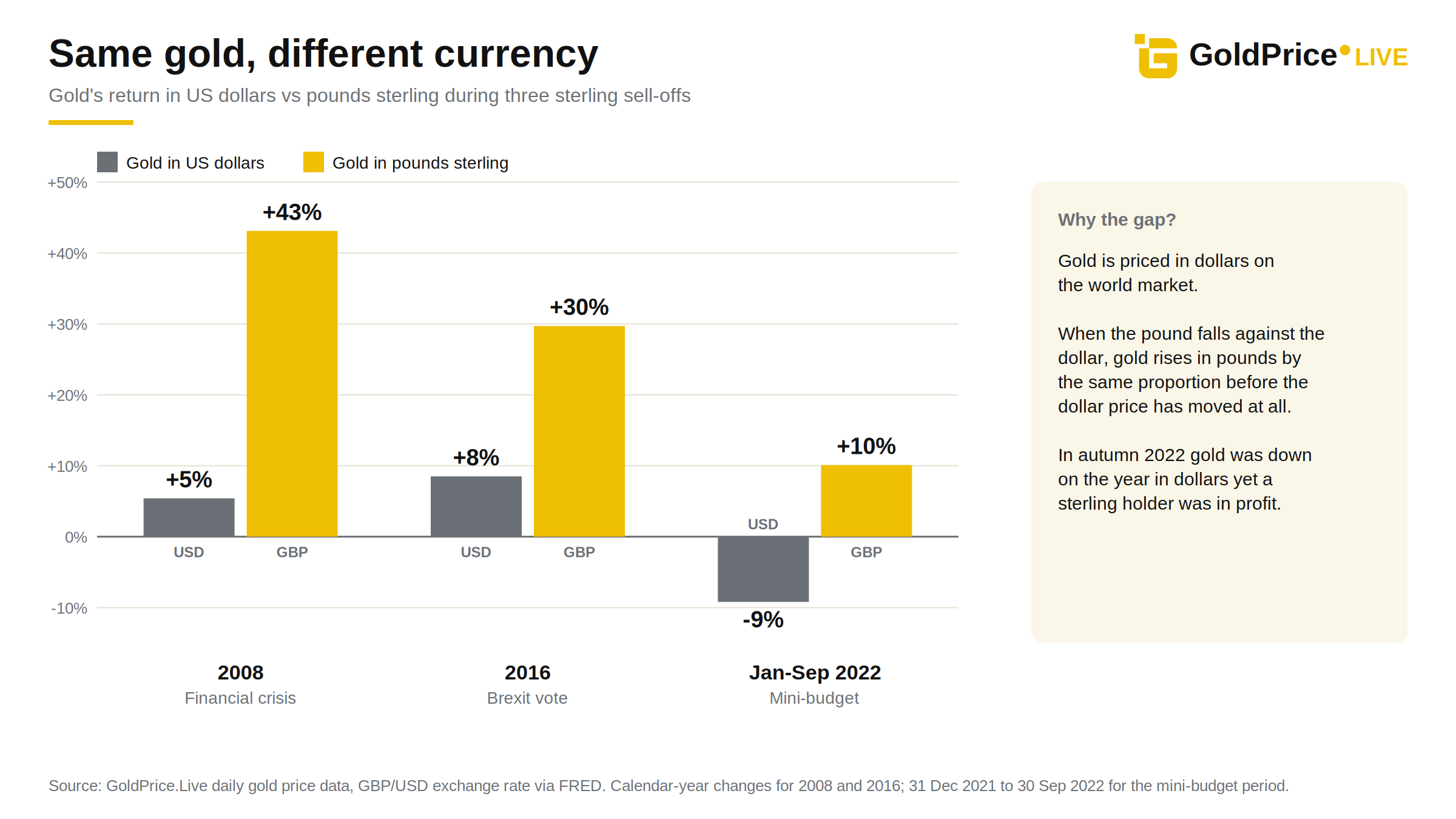
The inflation that gold hedges best is the violent kind, where a currency itself is losing credibility. Here the record is close to unblemished, and the reason is mechanical. Gold is priced in US dollars on the world market. If your home currency falls 30% against the dollar, gold rises 30% in your currency before the dollar price has moved at all. Domestic inflation, which usually follows a currency collapse, then adds to the effect.
I grew up in London, so sterling is the example I reach for. In 2008, gold rose about 5% in dollars; in pounds it rose 43%, because the pound fell by a quarter during the financial crisis. In 2016, the Brexit vote knocked sterling to a thirty-year low and a dollar gain of under 9% in gold became a sterling gain of nearly 30%. And in the first nine months of 2022, gold actually fell by 9% in dollars while rising 10% in pounds, as sterling slid to record lows around the mini-budget. A British saver holding gold through that period was protected from a crisis that the dollar price never registered.
The extreme cases make the same point more loudly. Turkish inflation reached 85% in late 2022 as the lira collapsed, and Argentine inflation ran into triple digits, with the peso losing most of its value in a few years. In both countries gold in local currency terms multiplied many times over, and households that held it preserved purchasing power that bank deposits could not. Go back further and the German hyperinflation of 1923 is the textbook case: a gold coin kept its real value while the paper mark went to zero.
This is why central banks, who understand currency risk better than anyone, have been net buyers of gold every year since 2010 and bought more than 1,000 tonnes a year in 2022, 2023 and 2024. Nobody buys a thousand tonnes to hedge next month's CPI. That's insurance against a loss of confidence in the money itself.
The decade that built gold's reputation deserves a closer look, because it shows both the power of the hedge and the volatility that comes with it.
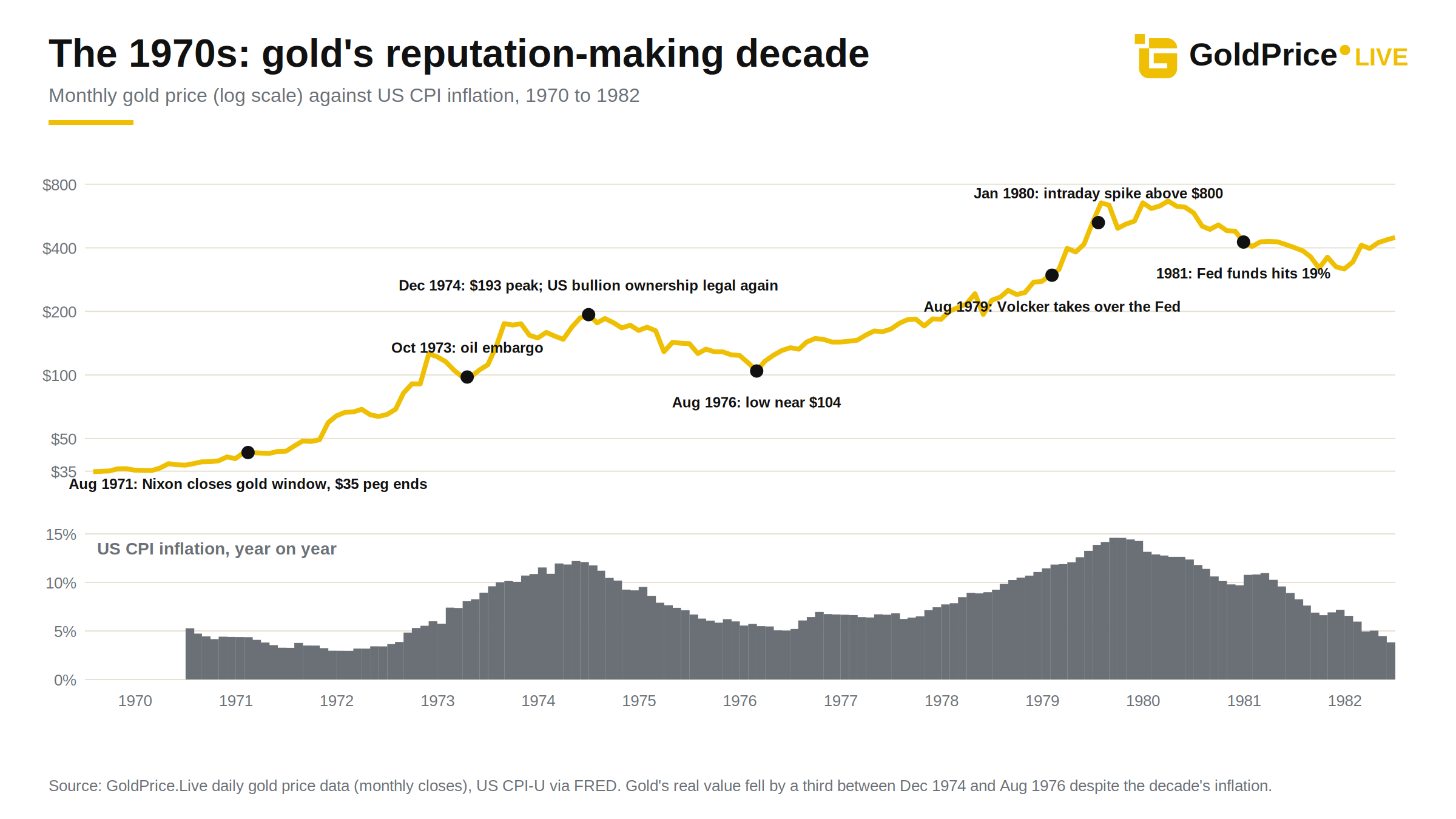
The starting gun was President Nixon closing the gold window in August 1971, ending the dollar's convertibility into gold at $35. The first oil shock followed in late 1973 and US inflation jumped from around 3% to 12% by 1974. Gold, now free to float, ran from $35 to $193 by the end of 1974: a five-fold move in three years. Sterling investors did even better, because the pound was sliding at the same time and UK inflation peaked at nearly 27% in 1975.
Then came the part people forget. From its December 1974 high, gold fell by almost half, bottoming near $104 in August 1976. Inflation had cooled to 5%, the Fed had raised rates, and gold's real value fell by a third in less than two years. If you'd bought at the 1974 top and held through 1976, you were losing to inflation, not beating it.
The second act was bigger. The 1979 oil shock sent inflation back above 13%, the US dollar was in open crisis, and gold rose 133% in 1979 alone. The January 1980 spike above $800 came in a near-panic over Soviet tanks in Afghanistan and American hostages in Tehran. Then Paul Volcker's Federal Reserve pushed the funds rate to 19% and real yields turned sharply positive. Inflation fell from 14% to 4% over the next three years, and gold fell with it, more than halving by the middle of 1982.
Across the full decade, gold beat inflation by a mile: roughly seventeen-fold against a doubling in prices between the end of 1970 and January 1980. But it did so in two bursts separated by a brutal bear market, and the people who made the most money were those who bought before inflation was obvious and sold while it was still frightening. Which is harder than it sounds.
The most recent inflation shock is the best test we have of the short-term hedge, because it unfolded in real time with modern data, and gold failed it before passing it.
US inflation lifted off in the spring of 2021 and peaked at around 9% in June 2022, the highest reading in four decades. Over those months, gold went sideways. From its August 2020 high of nearly $2,000 to its September 2022 low near $1,620, the dollar gold price fell about 16% while the CPI rose about 14%. For a holder measuring in dollars, that was a real loss of roughly a quarter during the very inflation gold was supposed to hedge.
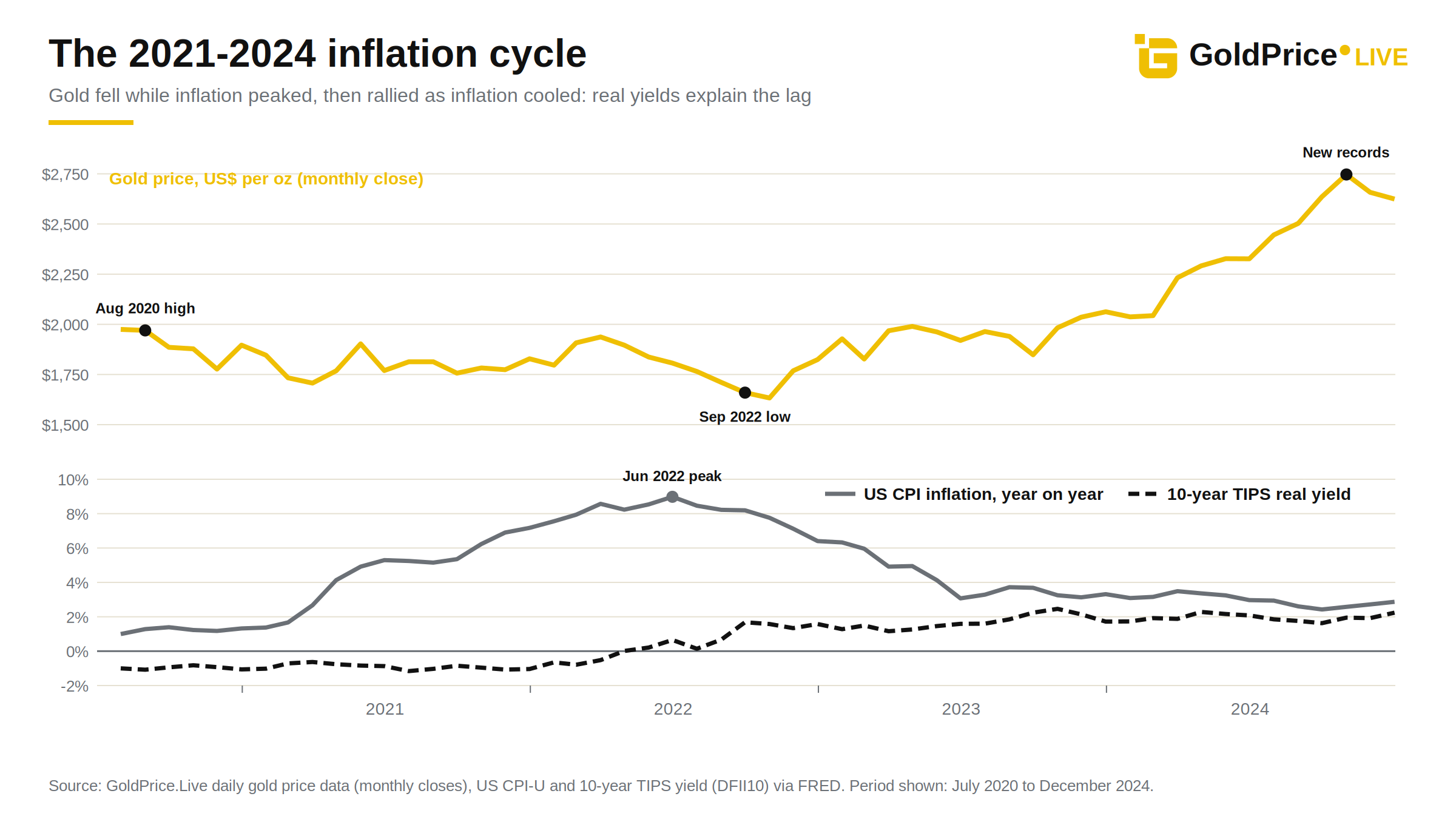
The real interest rate explains why. The Federal Reserve raised its policy rate from near zero in March 2022 to above 5% by mid-2023, and the ten-year inflation-protected Treasury yield swung from about minus 1% in 2021 to above 2% in 2023. That was the fastest tightening in forty years, and gold, which had rallied hard on negative real yields in 2020, gave back the premium.
What happened next is the interesting part. Inflation fell through 2023 and 2024, real yields held near 2%, and by the old playbook gold should have struggled. Instead it broke out to new records in 2024 and kept going. Central bank buying above 1,000 tonnes a year, Asian retail demand and a growing unease about government debt all pulled the price up while the CPI was cooling. Measured from the end of 2020 to the end of 2024, gold rose 38% against a 21% rise in consumer prices, so the full cycle was a win. The win just arrived two years later than the inflation did.
Pull those threads together and a practical picture emerges.
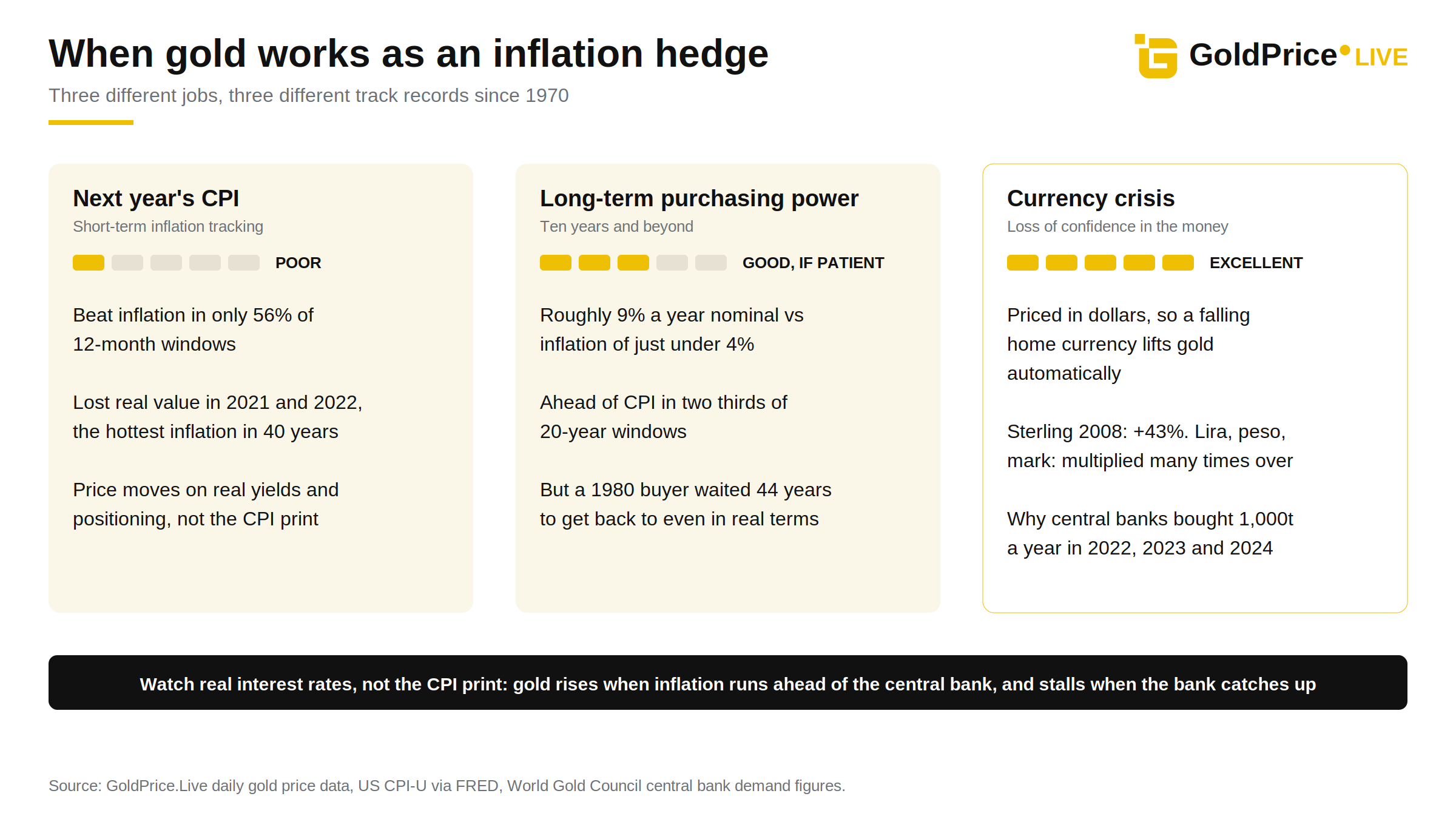
Gold is a poor tool for hedging the next twelve months of CPI. Its short-term price is driven by real interest rates, the dollar and investor positioning, and it has lost to inflation in nearly half of all calendar years since 1970. If you buy gold because you've just seen a hot inflation print, you may be buying after the move.
It's a good tool for protecting long-term purchasing power. Over most ten and twenty-year windows gold has beaten inflation, and over the full fifty-five years it has done so by a wide margin. The gold real return has been strongly positive for patient holders and strongly negative only for those who bought at the top of a mania and sold before the next cycle.
Where it shines is currency insurance. If the risk you worry about is not 4% inflation but a loss of confidence in the pound, the lira, the peso or eventually the dollar, gold is the asset with the longest track record of surviving that. The central banks are telling you the same thing with their reserves.
My own approach, after decades of watching these markets and four years running the Theseus research project on gold and silver history, is to hold a permanent allocation for the insurance value and to pay attention to real yields rather than the CPI when deciding whether to add. The metal has never been a thermostat for consumer prices. It is a barometer for trust in money, and inflation is just one of the things that erodes it.
If you'd like to see how a gold holding would have fared against inflation over any period since 1970, our gold investment calculator runs the numbers from the same price history used in this article.

Founder of GoldPrice.Live and GoldBuzz.com. Passionate about gold and silver. Designed the 4-year Theseus research project. Ex-British Aerospace and Scotland Yard, now based in Canada.