



 By GoldPrice.Live Market Desk •September 28, 2026
A reader wrote to me recently with a complaint I've heard a hundred times. He'd checked the gold price on his phone, driven to a dealer, and found the coins priced several percent higher than the number on his screen. Was the dealer having him on?
No - but I understand why it feels that way. The confusion comes from treating gold spot price vs market price as one thing when they're really two. The spot price is a wholesale benchmark: the price at which banks trade enormous bars with each other. The market price - what you actually pay for a coin or bar, sometimes called the retail or dealer price - is that benchmark plus the real-world costs of turning vault gold into something you can hold. Two honest numbers, doing two different jobs.
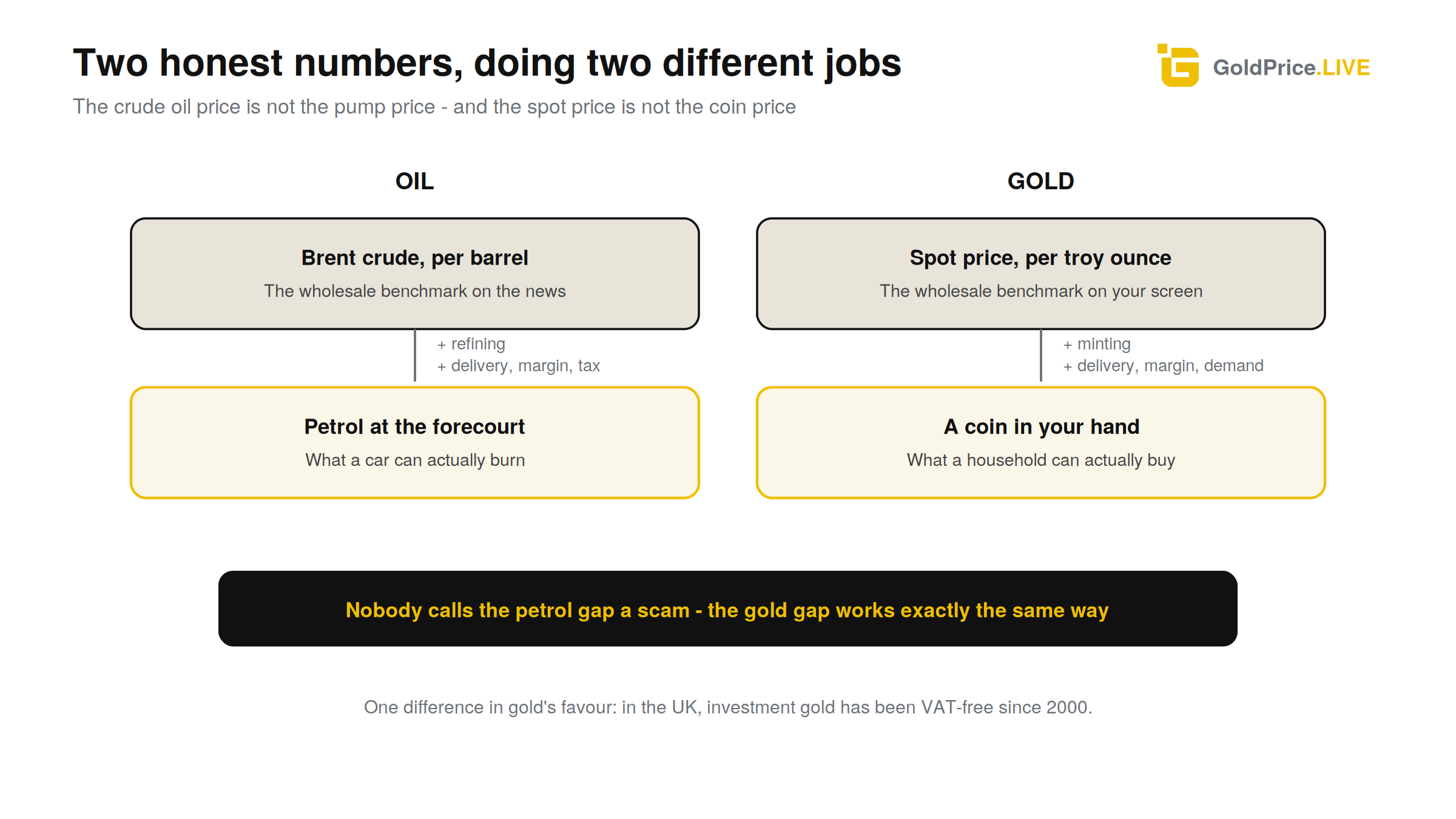
The best analogy I know is petrol. Brent crude has a famous global price, quoted by the barrel and flashed across the news every day. But nobody pulls up at a forecourt expecting to pay the crude price. Between the oil field and your fuel tank sit refining, transport, the retailer's margin and a healthy slug of tax. Nobody calls that a scam; it's just what it costs to turn crude into something a car can burn. Gold works the same way, only with far smaller gaps and, in the UK at least, no VAT on investment gold. This article walks through exactly what sits in that gap, and what happens on the rare occasions the gap goes haywire.
The spot price: gold's baseline number
Let's pin down the baseline first. The spot price definition gold professionals work from is simple enough: the price for immediate delivery of pure gold, quoted in US dollars per troy ounce, for wholesale quantities.
Every word in that sentence is doing work. Immediate delivery separates spot from futures, which we'll come to. Pure gold means 99.5 percent plus, the standard for the 400 ounce Good Delivery bars that trade in London. And wholesale quantities is the part retail buyers miss: spot is the price for bank-sized trades, discovered continuously across London dealing and New York futures. I covered that machinery in detail in my article on what the gold price is and how it's determined, so I won't repeat it here.
What matters for today's question is what the spot price is not. It is not an offer. No dealer anywhere will sell you a single ounce at spot, for the same reason no forecourt sells petrol at the crude price: the quoted number excludes every cost of getting the product from the wholesale market into your hand. Spot is the measuring stick, not the till receipt.
The market price: what the dealer actually charges
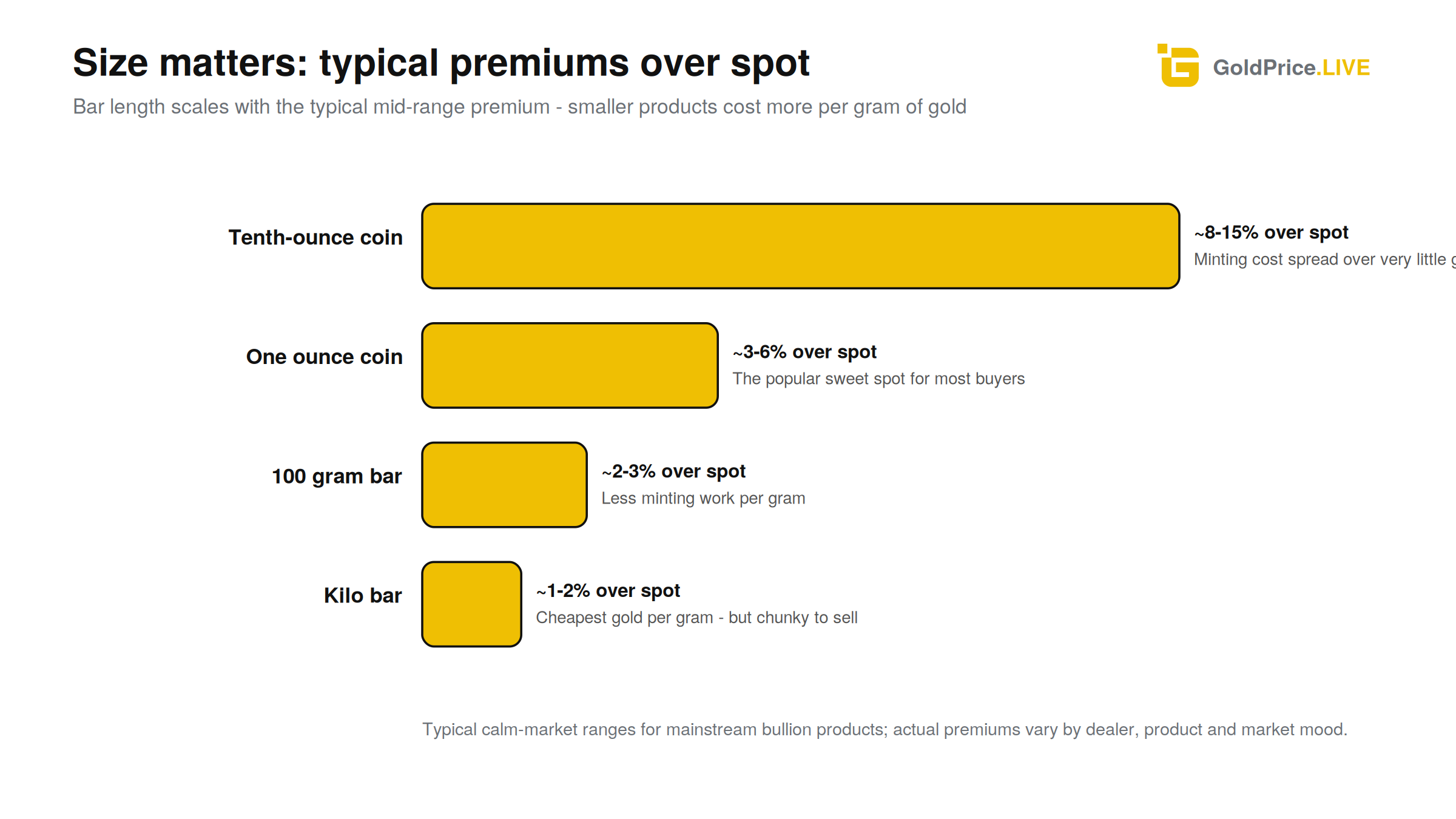
Walk into a dealer, or open their website, and you'll see the market price: spot plus a premium. For a popular one ounce coin like a Britannia, that premium typically runs a few percent in normal times. For a kilo bar it might be 1 or 2 percent. For a tenth-ounce coin it can reach 10 percent or more.
That percentage is the dealer markup as most people think of it, but the phrase is misleading, because most of it never reaches the dealer's pocket. It's a stack of costs collected along the way, and it's worth pulling the stack apart.
What's inside the premium: spot price vs retail price, layer by layer
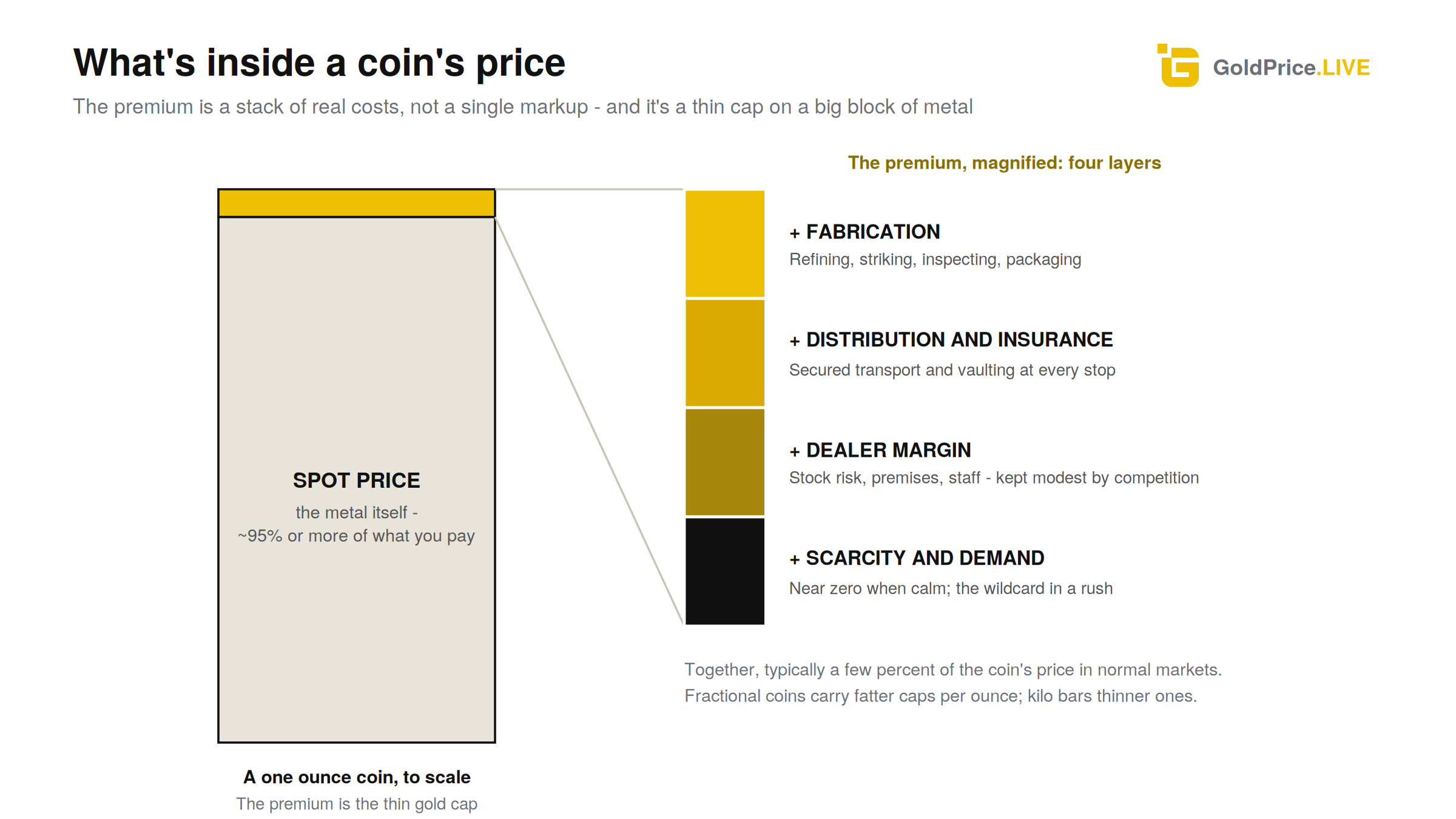
The gold premium over spot has four main ingredients.
Fabrication. Somebody has to refine the metal to coin purity, roll it, strike it, inspect it and package it. Minting a coin costs the same whether gold is cheap or dear, which is why fractional coins carry brutal percentage premiums: the minting cost is similar to a full ounce coin, spread across a tenth of the gold. It's the supermarket rule that small packets cost more per gram, cast in precious metal.
Distribution and insurance. Gold is heavy, valuable and stealable, so it travels in insured, secured logistics chains from refinery to mint to wholesaler to dealer, and it sits in vaults or safes at every stop. Each mile and each day of storage adds a sliver of cost.
The dealer's margin. The dealer holds stock, runs premises and websites, carries the risk that the price falls while inventory sits on the shelf, and needs to eat. Competition keeps this slice modest on popular products; on obscure ones it can be juicier, which is one reason mainstream coins are usually the better buy.
Scarcity and demand. The first three layers are fairly stable. The fourth is the wildcard. When retail demand surges, premiums rise even if spot doesn't move, because mints can't stamp coins any faster. In calm markets this layer is close to zero. In a panic it can briefly dwarf the other three combined - more on that in the final section.
One warning belongs here. Everything above describes bullion products, which are priced on their metal. Collectible and commemorative coins play by different rules entirely: their premiums reflect rarity, condition and fashion, can run to multiples of the gold value, and can evaporate just as easily. A proof coin in a velvet box at 40 percent over spot is not a gold investment with a big premium; it's a collectable that happens to contain gold. Nothing wrong with collecting - some people do very well at it - but know which game you're playing before you pay. If your aim is simply to own gold, plain bullion coins and bars, priced a modest distance over spot, are the right tools for the job.
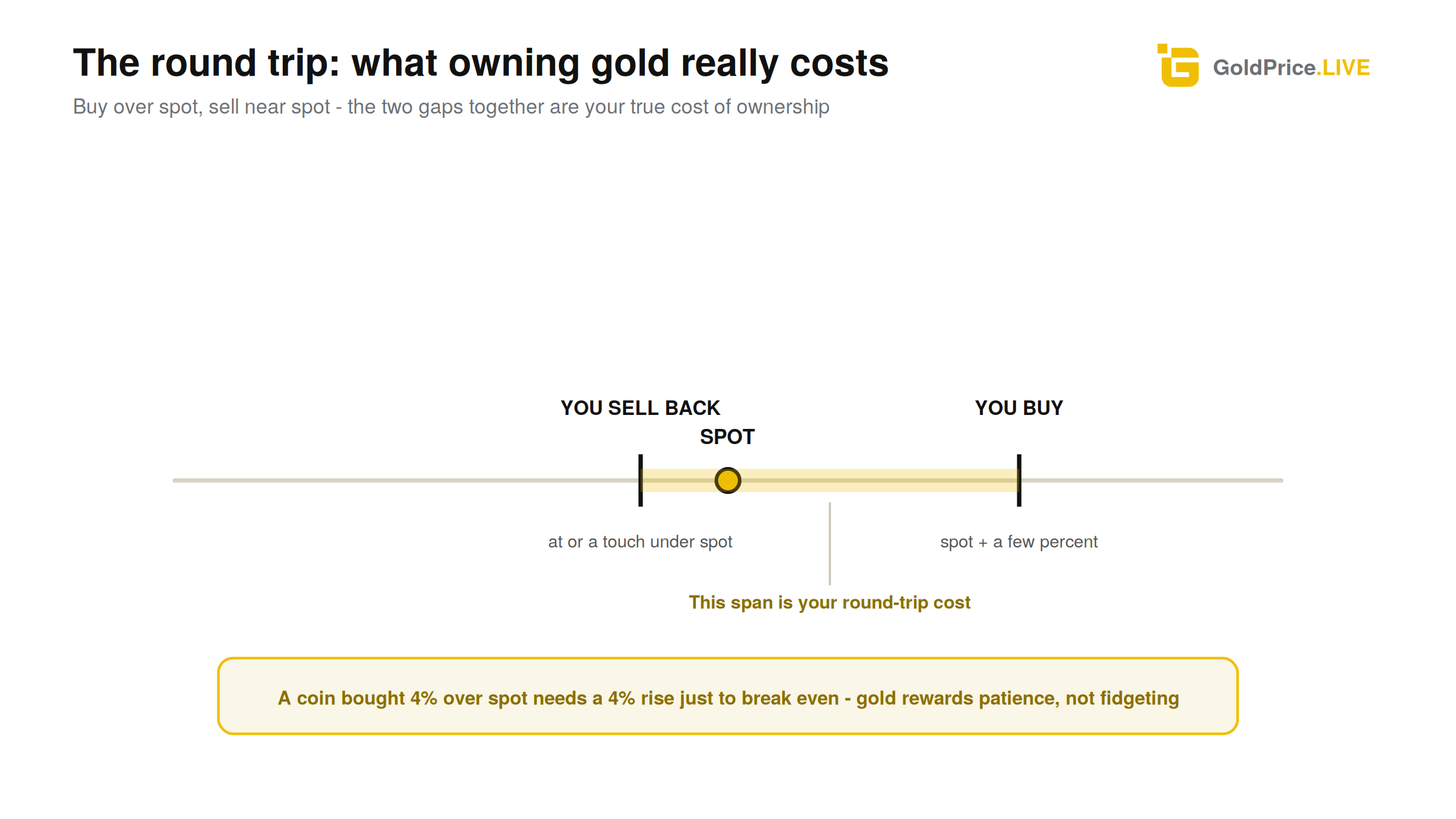
There's a mirror image on the way out, too. When you sell, the dealer quotes you a buyback price, usually at or a touch below spot. The gap between what they'll charge you and pay you is their bid ask spread, and it's the true measure of your round-trip cost. A coin bought at 4 percent over spot and sold back at spot needs the gold price to rise about 4 percent just to break even - which is why gold suits patient holders and punishes fidgety ones. I keep no secrets about this; it's the cost of owning something real.
Futures vs spot: the other market price
So far we've compared spot with the retail price. But there's a second "market price" that confuses people in a different direction: the futures price on your screen, which usually sits slightly above spot.
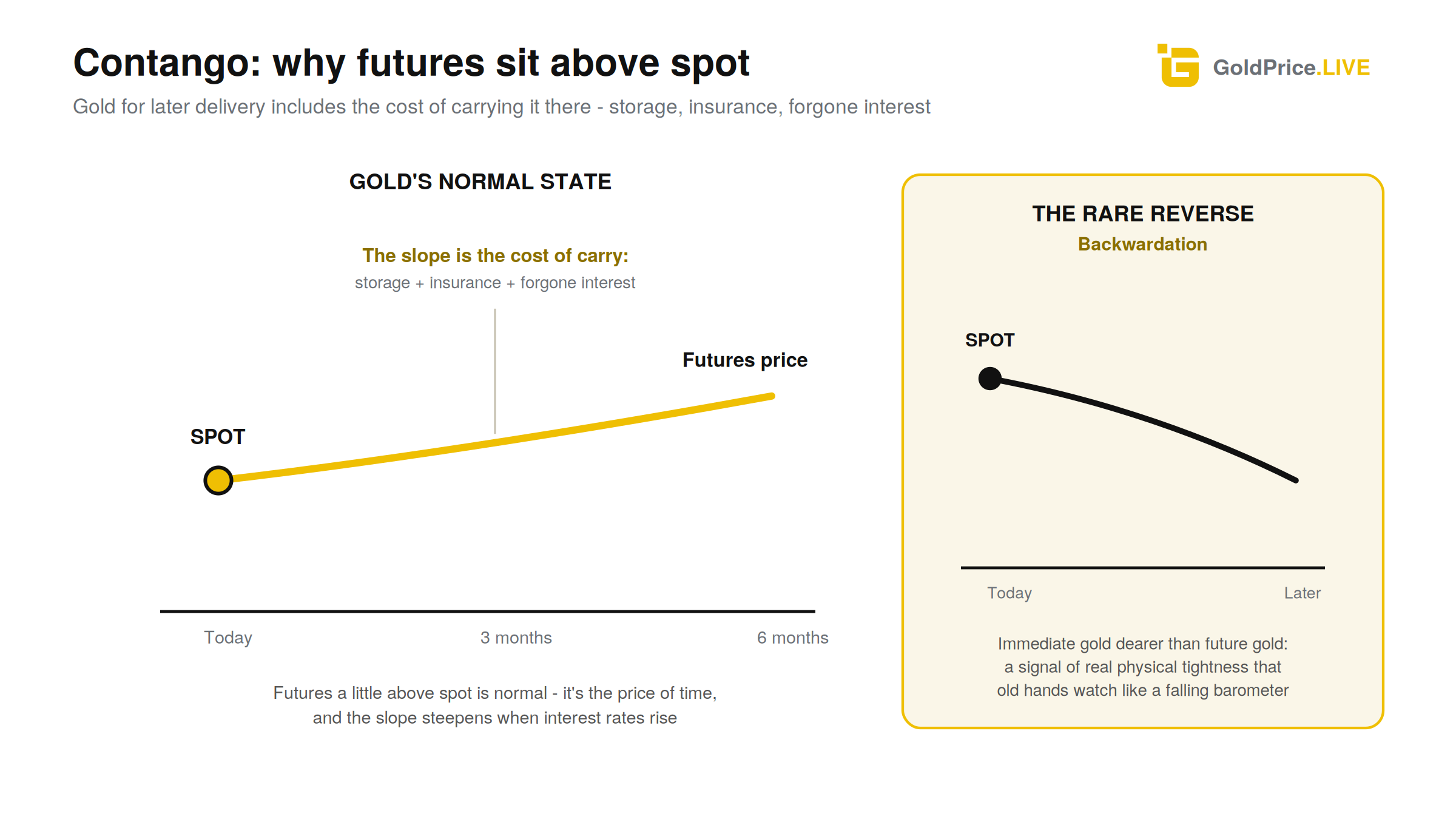
A futures contract is a promise to buy or sell 100 troy ounces at a fixed price on a set future date, traded on New York's COMEX. Because the seller of that promise must, in effect, hold gold until delivery day, the futures price bakes in the cost of carry: storage, insurance and, above all, the interest forgone by holding metal instead of cash. Gold for delivery in six months therefore normally costs a little more than gold today, and contracts further out cost a little more again. That gentle upward slope has a lovely piece of market jargon attached: contango.
Contango is gold's natural resting state, and the size of the slope mostly tracks interest rates - higher rates, steeper slope. The opposite condition, backwardation, is when gold for immediate delivery costs more than gold for future delivery. In most commodities that's routine. In gold it's rare and eyebrow-raising, because it means someone wants metal now badly enough to pay up for it - a signal of genuine physical tightness that old hands watch for the way sailors watch a falling barometer.
This is also the answer to a question I'm asked surprisingly often: why do different websites show slightly different gold prices at the same moment? Partly it's timing, as I've written before - the price never sits still. But partly it's sourcing: some feeds build their quote from the most active futures contract, others from spot dealing, others from a blend, and during US hours the futures market is often the liveliest reference. In calm conditions the differences amount to pennies and none of it matters. It only matters that you compare like with like: judge a dealer's premium against a spot quote, not a futures one, and don't be alarmed if two screens disagree by a dollar or two.
For everyday purposes, the takeaway is simpler: if the futures number on your screen is a few dollars above the spot number, nothing is wrong. That's not a discrepancy; it's the price of time.
When spot and market prices diverge most
In normal conditions, all these prices move as one animal. Spot, futures and retail track each other so closely that the differences are rounding errors. The interesting moments - and the instructive ones - are when they don't. Two kinds of stress pull them apart.
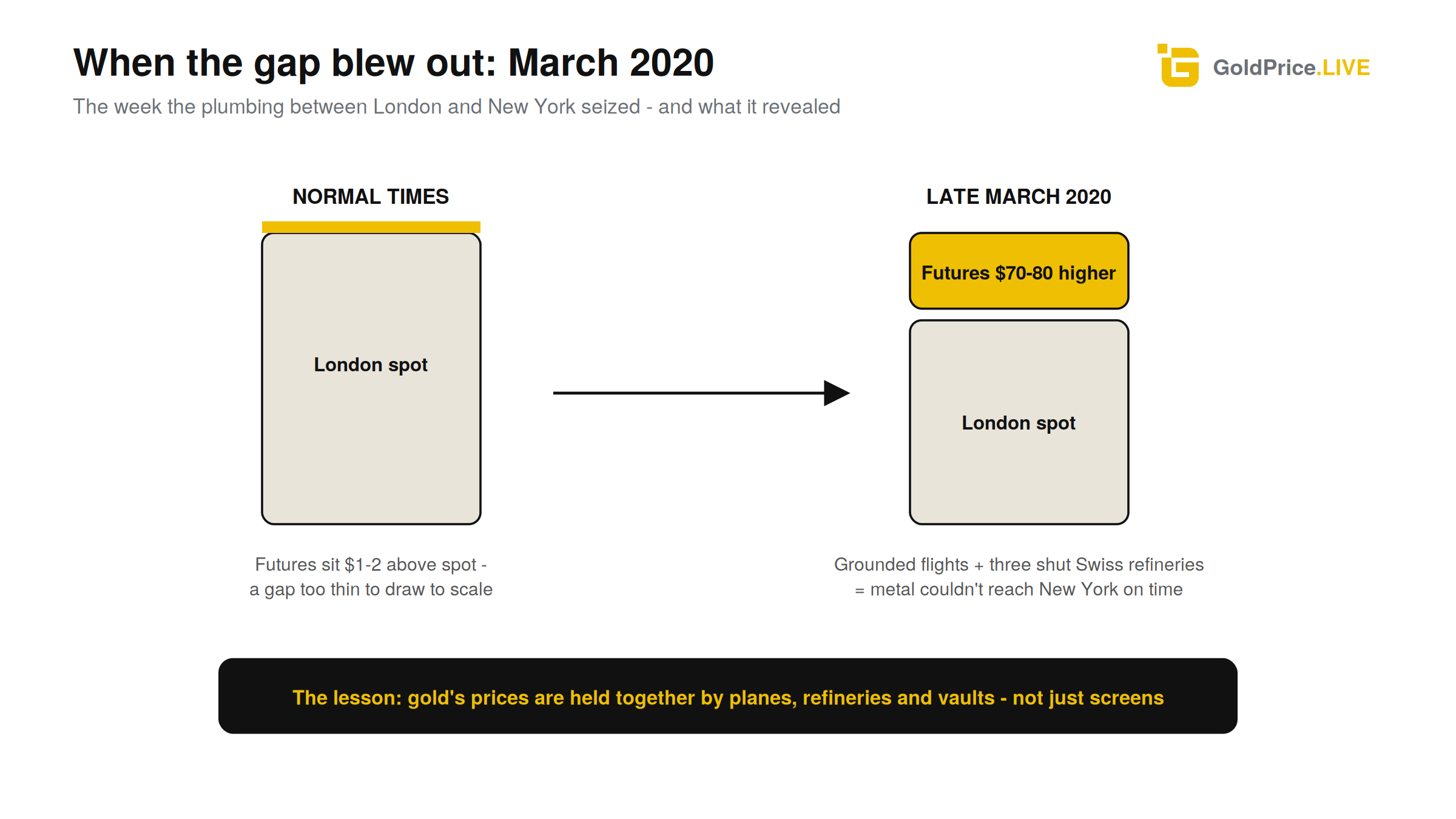
Stress in the plumbing. In March 2020, COMEX futures suddenly traded as much as 70 to 80 dollars above London spot, against a normal gap of a dollar or two. Nothing mystical happened: pandemic lockdowns grounded the passenger flights that, little known to most people, carry much of the world's gold in their holds, and three of Switzerland's giant refineries - the ones that melt London's 400 ounce bars into the 100 ounce bars New York's contracts require - shut their doors. Traders who'd promised delivery in New York suddenly couldn't be sure of getting metal there, and the futures price spiked to reflect that risk. A smaller rerun arrived in early 2025, when fears that US import tariffs might catch bullion pushed the gap out to around 50 dollars and sent a record 151 tonnes of gold across the Atlantic in a single month. Both episodes healed once the logistics unclogged, and both taught the same lesson: the world's gold prices are held together by planes, refineries and vaults, not just by numbers on screens.
Stress at the counter. The retail version is more familiar. In moments of public alarm - a banking scare, a war, a currency wobble - small bars and coins sell out, and retail premiums balloon even when spot is falling. Buyers in the spring of 2020 found themselves paying double-digit premiums for coins while the headline spot price was actually down on the month. The spot price said one thing; the price of gold you could physically get your hands on said another. Neither was lying. They were measuring different things: one the wholesale market in giant bars, the other the scramble for products a household can buy.
Divergence, in other words, is information. A blown-out futures gap says the plumbing between London and New York is strained. A blown-out retail premium says households are queuing for metal. Watch the gaps, not just the headline number, and the market will tell you things the headline never will.
The two-question test
Next time you compare the number on GoldPrice.Live with a dealer's quote, run two quick questions. First: what product, what size? A tenth-ounce coin at 10 percent over spot and a kilo bar at 1.5 percent over are both normal; the same percentage on both would be strange. Second: what's the market mood? A premium that would be steep on a quiet Tuesday is ordinary in a crisis week, and a quote below the usual range deserves as much suspicion as one above it - in gold, bargains that look too good usually are.
Spot is the truth about the wholesale market. The market price is the truth about what it costs to own gold in your hand, in your country, this week. Neither number is more real than the other, any more than the crude price is more real than the pump price; they simply answer different questions. Learn the normal distance between the two for the products you buy, and you'll spot both a fair deal and a fishy one at a glance - which, in the end, is the entire game.